
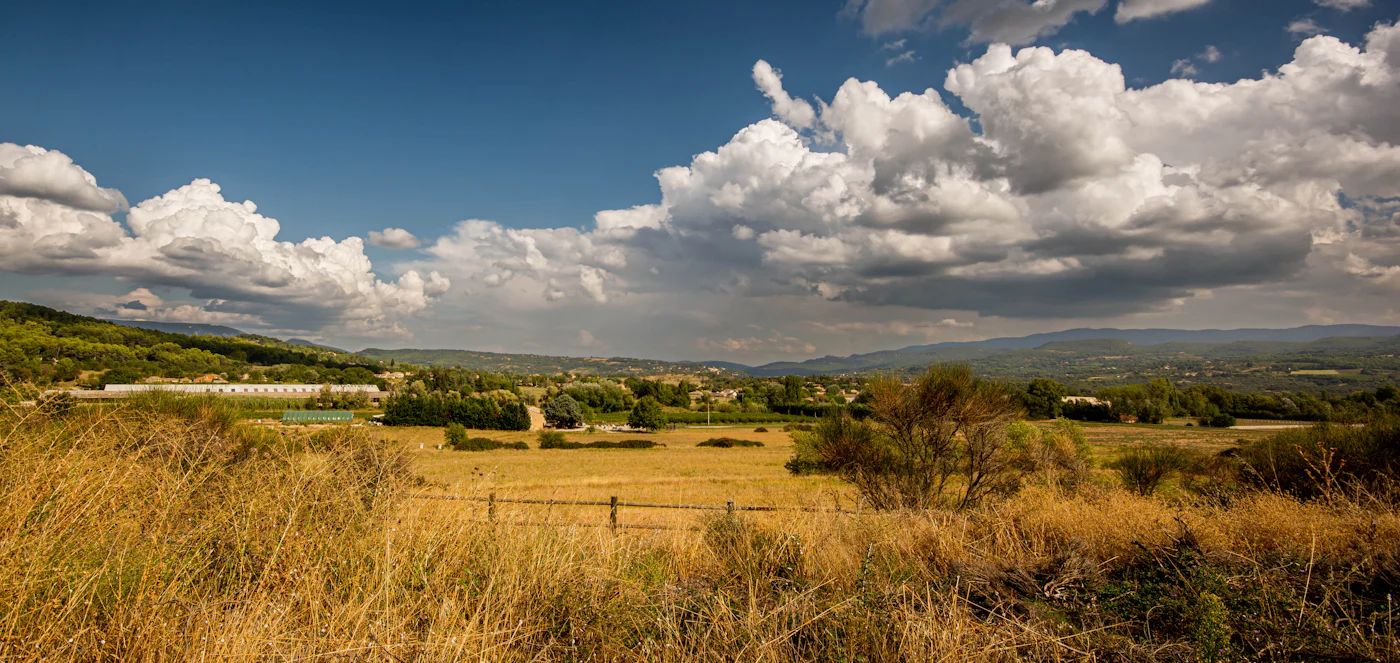
I pulled the van off the D2 highway just outside Gordes for what I told myself would be a two-minute photo stop, and ended up sitting on the hood for the better part of an hour, watching the golden-stone village catch the last of the evening light against the hills behind it. That’s the thing about the Luberon — everyone tells you it’s beautiful before you arrive, and you nod along, and then you actually see Gordes stacked up a hillside like something out of a painting, or Roussillon glowing orange-red against green cypress trees, and the pictures you’d already seen a hundred times online just don’t prepare you for it. This is the region of France that made me understand why so many writers and painters simply stopped travelling once they found it.
Provence is a big region, and most visitors try to cram too much of it into too little time, bouncing between Avignon, Aix, the Camargue, and Marseille without ever really settling anywhere. This guide does something different: it centres entirely on the Luberon, the hill-and-valley area east of Avignon that’s home to some of the most famous villages in France, and builds a full six-day, stop-by-stop itinerary around it, with the airport logistics, transport reasoning, and specific restaurant and viewpoint recommendations that most guides gloss over.
Why the Luberon Is the Heart of Provence
If you’ve ever seen a photo of a honey-coloured French village clinging to a hillside, framed by lavender fields or silvery olive groves, there’s a good chance it was taken somewhere in the Luberon. This is the Provence of Peter Mayle’s “A Year in Provence,” of countless painters chasing the region’s famous quality of light, and of some of the best farmers’ markets and restaurants in rural France. The area is anchored by a scattering of hilltop villages — Gordes, Roussillon, Ménerbes, Bonnieux, Lacoste, and more — each with its own distinct character, connected by winding D-roads through vineyards, cherry orchards, and, if you time it right, endless rows of purple lavender.
Unlike a single-city trip, the Luberon rewards a slower, looping approach: you pick a central base, and radiate out to a different village or landscape each day. That’s exactly how I’d structure six days here, and it’s the sequence below.
Getting There: Which Airport to Fly Into
You have a few solid options depending on where you’re coming from.
- Marseille Provence Airport (MRS) is the best-connected option for most international travellers, with a wide range of European routes and a handful of long-haul connections. From here, it’s about an hour and 15 minutes by car to the heart of the Luberon.
- Avignon TGV Station is the better choice if you’re already in France or connecting through Paris — the high-speed TGV from Paris Gare de Lyon takes as little as 2 hours 40 minutes, bookable through SNCF Connect or Trainline. Avignon sits right at the western edge of the Luberon and makes an excellent starting point.
- Nîmes Airport (FNI) is a smaller, budget-airline-friendly option (particularly well served by Ryanair from the UK and Northern Europe) about an hour from the Luberon.
My honest recommendation: if you’re flying internationally, route through Marseille and pick up a rental car there. If you’re coming from within France or already have a Paris leg on your trip, take the TGV to Avignon and rent your car from the station, which has desks for all the major companies right at the exit. Compare all routing options on Rome2Rio before booking.
Getting Around: You Need a Car for This One
Unlike some of the other regions I write about, there’s no real debate here: you need a rental car for the Luberon. The villages are connected by winding rural roads with limited and infrequent bus service, and the whole appeal of this region — chasing a viewpoint at golden hour, stumbling on a roadside lavender field, driving the ridge road between Bonnieux and Lacoste — depends entirely on having your own wheels and the freedom to stop wherever you like.
Pick up your car at Marseille Airport or Avignon TGV station, both of which have every major rental company represented (Europcar, Hertz, Sixt, Avis). A small-to-mid-size car is fine; the D-roads through the Luberon are well maintained, if narrow and winding in places, especially around the more dramatic hilltop approaches like Gordes and Roussillon. Parking within the villages themselves is usually in designated lots just outside the old centres, since most historic cores are pedestrian-only or too narrow for cars regardless.
Day 1: Arrival and Settling Into Your Base — Gordes or Isle-sur-la-Sorgue
However you arrive, drive straight into the region and get your bearings. I’d suggest basing yourself either in or very near Gordes itself for maximum atmosphere, or in Isle-sur-la-Sorgue if you want a flatter, more practical base with easier parking and a wonderful weekly market (more on that below).
- Afternoon: Settle in, then take your first walk through Gordes if that’s your base — wander up through the stacked stone streets to the château at the top for your first proper view over the Luberon valley.
- Evening: Watch the sunset from the Belvédère de Gordes, a viewpoint just outside the village on the D15 road, widely considered the single best spot to see the village lit gold against the hills. This is the postcard shot everyone comes for, and it earns the reputation.
- Dinner: Keep it simple your first night — a village restaurant terrace with a glass of local rosé and whatever’s fresh that day is the right way to start this trip.
Day 2: Gordes, the Abbey of Sénanque, and the Village des Bories
This is your deep-dive day into Gordes and its immediate surroundings, structured as a loop that takes in the region’s most photographed sights.
- Morning — Gordes village proper: Walk the full village at a slow pace before the day-trip crowds arrive — the stone houses here are built directly into the rock of the hillside, and the château (now partly a small museum) anchors the top of the village.
- Late morning — Abbaye Notre-Dame de Sénanque: A short drive down into the valley below Gordes brings you to this stunning 12th-century Cistercian abbey, famous for the rows of lavender planted right in front of its Romanesque facade. If you’re visiting in bloom season (roughly late June to early August), this is one of the single most photographed spots in all of Provence — go early to beat both the crowds and the heat. The abbey is a working monastery, so dress modestly, and check visiting hours in advance via the official Abbaye de Sénanque website, since it closes to visitors during prayer times.
- Midday — Village des Bories: Just outside Gordes, this open-air museum preserves a cluster of bories — small, dry-stone huts built without mortar, some dating back centuries, that were used historically by shepherds and farmers. It’s an easy, atmospheric stop that takes less than an hour.
- Afternoon — back to Gordes for lunch: Try La Renaissance or any of the terrace restaurants along the main square for a classic Provençal lunch — ratatouille, tapenade, and grilled lamb are all reliably good here.
- Evening: Return to the Belvédère viewpoint if the light looks promising, or simply relax at your accommodation — you’ve earned a slow evening after a full day of walking and driving.
Day 3: Roussillon and the Ochre Cliffs
Today’s destination is one of the most visually striking villages in France, and it deserves the full day.
- Morning — drive to Roussillon: About 20 minutes from Gordes, Roussillon sits directly on top of one of the largest ochre deposits in the world, and the entire village — walls, shutters, rooftops — is built in shades of red, orange, and gold that seem to glow, especially in morning and late-afternoon light.
- Mid-morning — Sentier des Ocres: Walk the “Ochre Trail,” a marked path through the old ochre quarries just outside the village, winding through surreal red-and-orange rock formations and pine forest. There’s a small entrance fee, and it takes 30-50 minutes depending on which loop you choose — book or check current opening times via the official Roussillon tourism site.
- Lunch: Eat in the village itself — the main square has several good terrace restaurants with views out over the ochre cliffs.
- Afternoon — Conservatoire des Ocres: If you want to understand the geology and history behind the pigment industry that once defined this village (ochre from Roussillon was exported worldwide for paint production well into the 20th century), this small working conservatory offers guided tours and even ochre-making workshops.
- Late afternoon — detour to Rustrel: If you have energy left, drive 20 minutes further to the “Colorado Provençal” near Rustrel, a larger and wilder set of ochre canyons with several hiking loops, far less crowded than the Roussillon trail.
Day 4: The Ridge Villages — Ménerbes, Lacoste, and Bonnieux
Today is a driving day along one of the most scenic ridge routes in Provence, taking in three villages that each have a very different character.
- Ménerbes: Start here — a quieter, more residential hilltop village that became internationally famous after Peter Mayle set “A Year in Provence” nearby. Wander the narrow streets and visit the small Musée du Tire-Bouchon (Corkscrew Museum) if you’re curious about one of the more eccentric small museums in France.
- Lacoste: A steep, dramatically situated village dominated by the ruins of the Château de Lacoste, once owned by the Marquis de Sade and more recently restored in part by fashion designer Pierre Cardin, who also revived the village’s summer arts festival. The climb up to the château ruins rewards you with sweeping views over the valley toward Bonnieux.
- Bonnieux: One of the larger and liveliest of the ridge villages, with a proper town centre, good restaurants, and a striking hilltop church reached by a long staircase. This is a good spot for a longer lunch stop — the village has more dining options than the smaller neighbours.
- Evening — sunset from the D109 ridge road: The road connecting these three villages runs along a high ridge with sweeping views across the whole southern Luberon valley toward Mont Ventoux in the distance. Time your drive back for sunset if you can; pull-offs along the road offer some of the best unofficial viewpoints in the region.
Day 5: Isle-sur-la-Sorgue Market Day and Fontaine-de-Vaucluse
Time this day for a Sunday or Thursday if you can, since those are the market days in Isle-sur-la-Sorgue, one of the best and largest markets in Provence.
- Morning — Isle-sur-la-Sorgue market: This antiques-and-produce market fills the streets of the whole town, with stalls selling everything from vintage furniture and linens to fresh lavender, olive oil, cheese, and Provençal fabrics. The town itself is built on channels of the Sorgue river, with old waterwheels still turning along the main streets — a genuinely lovely place to wander for a couple of hours, market day or not.
- Lunch: Eat canalside at one of the many riverside cafés and bistros — this is a relaxed, unhurried lunch kind of town.
- Afternoon — Fontaine-de-Vaucluse: A 15-minute drive brings you to this village, home to one of the largest natural springs in the world, where the Sorgue river emerges from a deep, mysterious pool at the base of a cliff. It’s a short, easy walk from the village car park to the spring itself, and in wetter months the flow is genuinely dramatic.
- Evening: Head back toward your base for a final relaxed dinner, ideally somewhere you haven’t yet tried.
Day 6: Lavender Fields (Seasonal) or Mont Ventoux, Then Departure
Your final full day depends heavily on the season.
If you’re visiting in lavender bloom season (roughly mid-June to early August)
Drive up toward the Plateau de Valensole, about an hour east of the Luberon, for the single most famous lavender-field landscape in France — vast rolling fields of purple stretching to the horizon, interspersed with the occasional lone stone farmhouse. This is a longer drive than everything else on this itinerary, but it’s the quintessential Provence photograph, and worth the detour if your dates align. Go at sunrise or early morning for both the best light and to avoid both the heat and the crowds that build through the day.
If you’re visiting outside bloom season
Drive up Mont Ventoux, the “Giant of Provence,” a bald limestone peak famous from the Tour de France that towers over the entire region. The summit road offers sweeping views across the whole of Provence on a clear day, all the way to the Alps in one direction and the Mediterranean in the other. It’s also become a pilgrimage climb for cyclists worldwide, so expect to share the road with a fair number of them in road bikes and full kit.
Whichever you choose, use the rest of the day for a final wander through whichever village you loved most, before heading back to Marseille Airport or Avignon TGV station for departure.
Practical Tips for Planning Your Trip
- Best time to visit: Late June through early August for lavender bloom, though this is also peak season with the biggest crowds and highest prices. May, September, and early October offer a quieter, still-warm alternative with fewer crowds, golden light, and (in autumn) the grape harvest as a bonus. Avoid August if you can — it’s when most of France itself is also on holiday here.
- Language: French is essential in the smaller villages; English is spoken in tourist-facing businesses but far less reliably than in bigger cities, so a few basic French phrases go a long way.
- Booking ahead: Reserve accommodation in Gordes or Roussillon well in advance for summer, since both villages are small with limited rooms. Market-day parking in Isle-sur-la-Sorgue fills fast — arrive early.
- Currency: Euros, and card is widely accepted, though smaller village market stalls often prefer cash.
- Journey planning: Use Rome2Rio or SNCF Connect to check any train alternatives if you’re arriving without a car already booked.
- Sunday and Monday closures: Many village restaurants and shops close on Sunday evenings and all day Monday, a pattern common across rural France — plan your must-visit meals around this rather than around it.
- Fuel stops: Petrol stations can be sparse in the smaller village stretches, so top up in Avignon, Cavaillon, or Apt rather than assuming you’ll find one along the ridge roads.
- Toll roads: If you take the autoroute from Marseille or Avignon toward the Luberon, expect a small number of péage toll stops, payable by card at the automated booths.
Where to Eat: Beyond the Village Lunch Spots
Provence rewards eating seasonally and simply, but there are a handful of destination restaurants worth planning a meal around.
- La Bastide de Marie, near Ménerbes, offers refined Provençal dining in a converted 19th-century wine estate, with a gorgeous vineyard-view terrace.
- For fine dining with real ambition, check the Michelin Guide for current Luberon-area listings — several one-star restaurants operate in and around Gordes and Bonnieux, with menus that change seasonally around whatever the local markets are offering that week.
- For something more casual but memorable, seek out any restaurant serving a proper soupe au pistou in summer, or a rich daube provençale (slow-braised beef stew with red wine) if you’re visiting in the cooler months.
- Don’t skip the village boulangeries for breakfast — a fougasse (the local olive-studded flatbread) from a good village bakery is one of the simple pleasures of this trip.
A Little History: Why This Landscape Looks the Way It Does
The Luberon’s famous hilltop villages weren’t built for the view — they were built for defence. Through the medieval period and well into the Wars of Religion in the 16th century, this region was fought over repeatedly, and villages perched on defensible high ground with a single narrow approach, exactly the layout you still see in Gordes, Bonnieux, and Ménerbes today. The distinctive golden stone came from local quarries and was the practical building material at hand, which is part of why the whole region shares such a cohesive architectural palette even between villages that never coordinated with each other.
The area’s more recent fame owes a great deal to a wave of 20th-century artists, writers, and eventually wealthy second-home buyers from Paris, the UK, and further afield, who “discovered” the Luberon from the 1950s onward and gradually restored many of its once-crumbling villages. Peter Mayle’s bestselling books in the 1980s and 90s accelerated that international fame considerably, particularly around Ménerbes, and you’ll still meet a fair number of expatriate residents in the villages today, running small guesthouses, galleries, and restaurants alongside the long-established French families who never left.
Where to Stay: Choosing Your Base
- Gordes: The most atmospheric and photogenic base, with the tradeoff of being the busiest and priciest village, especially at midday when tour buses arrive. Staying overnight lets you enjoy it in the quiet early morning and evening hours after the day-trippers leave.
- Isle-sur-la-Sorgue: A flatter, more practical base with easier parking, a wonderful market, and a slightly more “real town” feel rather than a postcard village. A smart choice if you’re travelling with kids or want easier logistics.
- Bonnieux or Lourmarin: Both offer a good middle ground — real villages with a strong local feel, good restaurants, and slightly better value than Gordes, while still being centrally located for day-tripping around the whole Luberon.
- Countryside gîtes and farmhouses: If you want the classic Provence experience — a stone farmhouse surrounded by lavender or vineyards — renting a gîte for the week rather than staying in a village itself is a lovely option, though it does mean more driving for meals and markets.
Frequently Asked Questions
Is the Luberon worth visiting outside lavender season?
Completely — the villages, the ochre cliffs, the markets, and the food are all wonderful year-round, and you’ll trade the lavender photo for smaller crowds, better restaurant availability, and (in spring and autumn) a genuinely lovely, softer landscape.
How many villages can I realistically see in six days?
This itinerary covers roughly seven to eight — Gordes, Roussillon, Ménerbes, Lacoste, Bonnieux, Isle-sur-la-Sorgue, Fontaine-de-Vaucluse, plus the ochre trails and either Valensole or Mont Ventoux — which is a genuinely full but unrushed pace. Trying to add significantly more risks turning this into a windshield tour rather than a real visit to each place.
Do I need to speak French?
Not strictly, but it helps enormously in the smaller villages, where English is spoken less consistently than in Paris or the Côte d’Azur. A polite “bonjour” before any interaction goes a long way in France generally, and especially in rural Provence.
Can I do this trip without a car if I stay in one village?
Not really, and I’d gently push back on trying — public transport between these villages is sparse and infrequent, and the whole point of the Luberon is the freedom to chase light, detour on a whim, and cover ground between small, spread-out villages. This is a driving trip at its core.
What to Pack
- Comfortable walking shoes with grip. Village streets are cobbled and often steep, and the ochre trails and bories site involve uneven, sandy or rocky terrain.
- Sun protection. Provence gets serious summer heat, often into the mid-30s°C, with little shade in the lavender fields or on the ochre trails.
- A light scarf or shawl for abbey visits. Sénanque and other religious sites expect modest dress.
- A reusable water bottle. Village fountains throughout the region often run drinkable water — refilling as you go is both practical and very Provence.
- A good camera or phone with plenty of storage. You will take far more photos here than you expect to.
- A cooler bag for market finds. Between the cheese, charcuterie, and fresh produce at Isle-sur-la-Sorgue and the village markets, you’ll want somewhere to keep purchases fresh on hot drives between stops.
- An offline map or downloaded route. Mobile coverage is generally solid in the Luberon’s main villages but does drop out on some of the smaller connecting roads, particularly on the ridge route between Lacoste and Bonnieux.
Photography Tips for the Region’s Famous Light
Provence’s light has a genuine reputation among painters and photographers, and a few small adjustments to your schedule will make a real difference to what you come home with. The golden hour here lasts noticeably longer than in many other parts of Europe, thanks to the region’s latitude and the way the light interacts with the ochre and limestone landscape, so both early morning and the last two hours before sunset are worth prioritising over the harsh midday sun for village and viewpoint shots. The Belvédère de Gordes and the ridge road near Lacoste both face roughly the right direction for a strong evening light; Roussillon’s ochre cliffs, by contrast, often look their most vivid in the softer light of early morning, before the sun is directly overhead and washes out the colour contrast. If you only have room in your schedule for one dedicated “golden hour chase,” I’d point you toward Gordes at sunset over any of the other options on this itinerary — it’s the view that best captures why this region has such an outsized reputation.
Optional Extension: Avignon’s Old Town and the Palais des Papes
If you fly into Marseille or arrive via the TGV at Avignon, it’s worth carving out a half-day, either at the start or end of your trip, to explore Avignon itself before heading into the Luberon proper. The walled old town is dominated by the extraordinary Palais des Papes, the largest Gothic palace in the world and seat of the papacy during its 14th-century relocation from Rome — a genuinely fascinating piece of medieval history, and tickets are best booked ahead through the official Palais des Papes website to skip the queue. Pair it with a walk out onto the famous half-collapsed Pont Saint-Bénézet (the “Pont d’Avignon” of the French nursery rhyme) for classic river views back toward the palace walls. Avignon also hosts one of France’s most important theatre and arts festivals every July, so if your dates overlap, expect a livelier — and pricier — old town than usual.
A Deeper Look at the Lavender Season
Lavender is the single image most people associate with this region, but the timing is genuinely narrow and worth understanding properly before you plan around it. The Luberon and the wider Vaucluse typically see bloom from mid-June through the end of July, peaking around the second and third weeks of July in most years, though exact timing shifts with the weather each season. The larger, more famous fields on the Plateau de Valensole (technically just outside the Luberon proper, in the neighbouring Alpes-de-Haute-Provence) tend to bloom slightly later than the smaller fields closer to Sault and the slopes of Mont Ventoux, so if you’re visiting right at the edges of the season, it’s worth checking which specific area is currently in bloom rather than assuming the whole region blooms simultaneously.
A few tips if lavender photography is a priority for your trip:
- Go early. Fields near Valensole and Sault get busy with photographers and tour groups from mid-morning onward in peak season; sunrise gives you both the best light and near-empty fields.
- Respect the farms. These are working agricultural fields, not photo sets — stay on marked paths and field edges, and never walk directly into rows to avoid damaging the crop ahead of harvest.
- Consider the Sault plateau as an alternative to Valensole. It’s closer to the Luberon base described in this itinerary, sits at higher altitude (meaning slightly later, cooler bloom), and sees noticeably fewer tour buses than Valensole.
- Harvest season has its own charm. Late July into August, when the lavender is cut and distilled, fills the whole region with a genuinely incredible fragrance, and several local distilleries offer tours of the process if you’re travelling right at that time.
Wine Tasting in the Luberon
Provence is famous worldwide for its rosé, and the Luberon has its own small but well-regarded appellation, Côtes du Luberon, producing crisp, food-friendly rosés alongside some increasingly serious reds and whites. A wine-focused afternoon slots in naturally around Days 2 or 4 of this itinerary.
- Château La Canorgue, near Bonnieux, is a well-known organic estate (and the filming location for the 2006 film “A Good Year”) offering tastings and tours through its vineyards.
- Domaine de la Citadelle, also near Ménerbes, pairs a working vineyard with an eccentric and genuinely interesting corkscrew museum, making it a fun stop even if wine isn’t your main focus.
- Most villages also have a local cave coopérative (cooperative winery) where you can taste and buy directly from a range of small regional producers under one roof — a good, low-pressure way to sample widely without committing to a full estate tour at every stop.
If you plan to taste seriously, designate a driver for the day or split the group, since public transport genuinely isn’t an option for hopping between these rural estates.
Hiking and Slower Ways to Experience the Luberon
If you want to balance out all the driving with some time on foot beyond the village streets, the Luberon has excellent, well-marked hiking that rewards even a single half-day detour.
- The Ridge Trail near Bonnieux and Lacoste: Sections of the GR6 long-distance trail cross this exact stretch of ridge, and a short there-and-back walk from either village gives you sweeping valley views without needing to commit to a full day’s hike.
- Colorado Provençal, Rustrel: Beyond the short loop mentioned on Day 3, longer marked trails here wind deeper into the ochre canyon system, taking two to three hours if you want a proper half-day hike away from the road.
- Forêt des Cèdres, above Bonnieux: A cool, shaded cedar forest planted in the 19th century, with gentle walking trails and, on clear days, views stretching out over the whole Luberon valley — a good option if you’re visiting in the heat of summer and want relief from the sun.
Sample Budget for Six Days
Provence sits at the pricier end of rural France, particularly in peak summer, though it’s still generally better value than the French Riviera further south.
- Budget traveller: €80-110/day — simple gîte or guesthouse room, village bakery breakfasts, one market-stall or casual lunch and a modest dinner, self-driving in a compact rental.
- Mid-range: €160-250/day — boutique village hotel or a nicer gîte, a proper sit-down lunch or dinner most days, one or two paid activities (Sénanque, ochre trail entry, a wine estate tour), mid-size rental car.
- Higher-end: €400+/day — a restored bastide or luxury countryside hotel, Michelin-listed dining, private wine tours, and premium accommodation directly in Gordes or Bonnieux.
Rental cars typically run €40-70/day in shoulder season, considerably more in July and August when demand across the whole of southern France peaks — book as early as possible if you’re travelling in peak summer.
Combining This Trip With the Rest of Provence and the Côte d’Azur
If you have more time, the Luberon connects naturally onward in a couple of directions. South and east, roughly an hour and a half away, you reach the lavender-and-olive landscapes around Aix-en-Provence and, further still, the glamour of the Côte d’Azur around Nice and Cannes — a completely different, more coastal and cosmopolitan side of the same broader region. West, toward Arles and the Camargue, you trade hilltop villages for flat wetlands, wild white horses, pink flamingos, and Van Gogh’s old haunts, an easy day trip or overnight addition if you want to round out a longer Provence itinerary. I’d resist the urge to try to do all of it in one trip, though — the Luberon rewards the unhurried pace described in this guide, and bolting on too many other regions tends to flatten exactly the slow, village-to-village rhythm that makes it special in the first place.
Why This Corner of Provence Stays With You
I’ve driven a lot of beautiful roads across Western Europe at this point, but there’s something particular about the Luberon that keeps pulling me back — maybe it’s the light, which really does have that soft golden quality every painter and photographer talks about, or maybe it’s just the rhythm the region imposes on you almost against your will. You can’t rush a market morning in Isle-sur-la-Sorgue. You can’t rush the walk up to Lacoste’s château ruins in the midday heat. You end up moving at the pace of the place itself, which turns out to be exactly the point. Fly into Marseille or take the TGV to Avignon, pick up a car, and give yourself the better part of a week among these hilltop villages — by the third golden-hour stop you didn’t plan for, you’ll understand completely why this small pocket of France has been pulling in wanderers, painters, and stubborn van-lifers like me for the better part of a century.
What makes the Luberon different from a lot of bucket-list European regions is how well it rewards patience over ambition. You could theoretically drive through every famous village in a single frantic day, snap the requisite photos at each one, and move on to the next region on your list. Almost nobody who does that comes away with the trip they were hoping for. The version of this region that actually stays with you is the slower one: the market morning you didn’t rush through, the extra twenty minutes at a viewpoint because the light kept shifting and you couldn’t bring yourself to leave, the lunch that ran two hours longer than planned because the conversation with the restaurant owner got genuinely interesting. This itinerary is built to leave room for exactly that kind of trip, and I’d gently encourage you to protect that room even when it’s tempting to squeeze in one more stop. The Luberon has been patiently waiting there in the hills for a very long time; it isn’t going anywhere, and neither, really, should you be in a hurry to move through it.
Photo by Hugo Kruip on Unsplash.