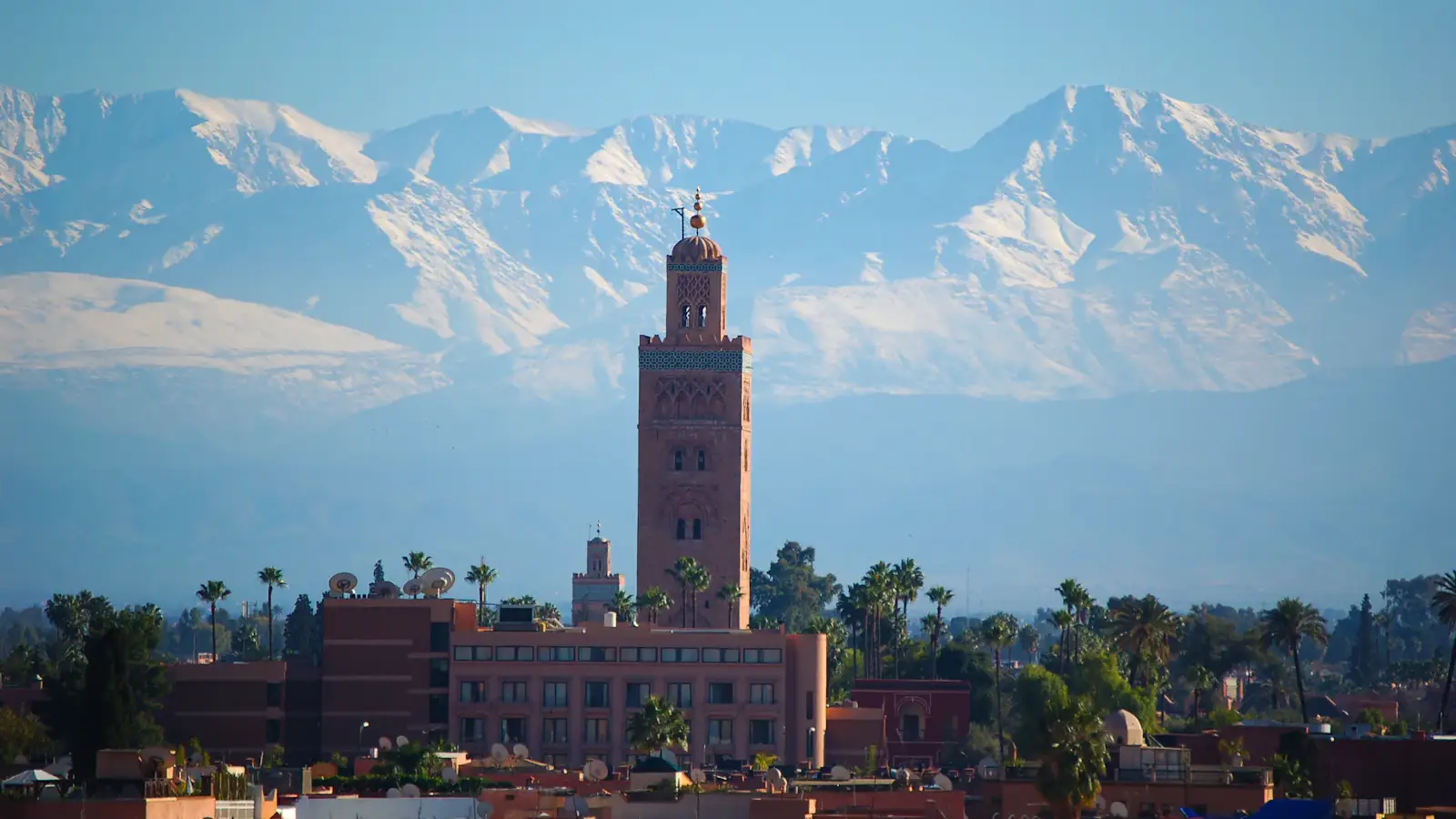
The ferry from Tarifa to Tangier takes just under an hour, and somewhere in the middle of that crossing — the coast of Spain shrinking behind us, the hills above Tangier sharpening into focus ahead — I got the same feeling I got the very first time I drove this van across a border: the rules are about to change again, and I still haven’t gotten used to how much I love that. Three weeks ago, that hour on the water was the opening move in a longer drive south, one that ended, eventually, in Marrakech, Morocco, in a dusty parking lot just outside the medina walls, engine ticking as it cooled, while a guardian in a blue djellaba was already walking over to negotiate a nightly rate for watching the van.
Getting There: A Ferry, a Long Drive South, and No Cars Allowed
Cars — vans very much included — are not allowed inside Marrakech’s old medina, and the first thing I’d tell anyone doing this drive is to make peace with that before you arrive, not after you’ve spent twenty minutes trying to nose a vehicle down an alley built for donkeys. From Tangier, it’s roughly a six-hour drive south on the toll motorway to Marrakech, dropping out of the Rif foothills, through Rabat and Casablanca’s outskirts, and finally into the red-walled city itself. If you’re not bringing your own vehicle, Marrakech Menara Airport (RAK) is the easiest way in for most travellers, with direct flights from a wide spread of European cities, and it sits close enough to the medina that a petit taxi from the terminal rarely takes more than twenty minutes.
Whichever way you arrive, plan to park (or get dropped) at one of the guarded lots ringing the medina — ours was a short walk from Bab Doukkala — and do the last stretch to your riad on foot or by handcart, because that’s genuinely how it works here. Our riad sent a porter to meet us at the gate with a wooden cart for the bags, and he wound us through maybe a dozen turns I could not have retraced if my life depended on it.
Settling In: First Night in the Medina
We were staying in a riad two turns off a passage so narrow that the walls on either side nearly brushed both shoulders at once, and the door — like every riad door in the medina — gave no hint of what was behind it. You knock, it opens, and suddenly you’re standing in an open-air courtyard with a plunge pool, orange trees, and three storeys of carved cedar balconies looking down at you. It’s a genuinely disorienting kind of beautiful, and after nine hours of driving that day, I sat by that pool for a solid twenty minutes before I could make myself get up and go find dinner.
Dinner, that first night, was the obvious move: Jemaa el-Fnaa, the main square, which by dusk turns into the loudest, most alive public space I’ve stood in anywhere on this trip so far. Orange juice stalls stacked six deep, snake charmers working the crowd for tips, and dozens of open-air food stalls sending grill smoke up into the floodlit minaret of the Koutoubia Mosque behind it all. We ate merguez sausage and a bowl of harira soup standing at a communal counter, paying in cash, surrounded by a mix of locals breaking their day and tourists doing exactly what we were doing — trying to take in too much at once.
Souks, Palaces, and a Garden Full of Blue
The next two days were mostly on foot, and mostly lost, which in the medina I’ve come to think is the point. We wandered the souks north of the square — the dye souk with wool hanging in skeins of every colour, the leather souk where the smell hits you before the stalls do, the metalwork souk ringing with hammer strikes — buying almost nothing but stopping constantly, because a shopkeeper’s opening line here is rarely “buy this” so much as “come, just look, no obligation,” and half the fun is the back-and-forth that follows whether or not money ever changes hands.
Two stops were worth planning the day around rather than stumbling into. The first was the Bahia Palace, a nineteenth-century vizier’s residence with courtyard after courtyard of zellige tilework and painted cedar ceilings, quiet enough in the early morning that you can actually hear your own footsteps on the marble. The second was Jardin Majorelle, the cobalt-blue garden restored by Yves Saint Laurent, which is small enough to see properly in an hour but photogenic enough that we stayed for two. Both charge a modest entry fee and both are worth booking a slightly earlier slot for, since the tour-bus crowds thicken fast after mid-morning.
Where We Ate
Marrakech might be the best city for food I’ve visited on this whole trip, and three places in particular earned repeat mentions in my notebook. Café des Épices, tucked into the Rahba Kedima spice square, does a rooftop breakfast of msemen flatbread and Moroccan mint tea that we went back for twice — order the almond amlou if it’s on the board that day. For dinner, Le Jardin is a converted riad with an interior courtyard garden that feels like eating inside a jungle, and their grilled vegetable tagine was the best version of that dish I had all week. And on our last night, we splurged on Nomad, whose rooftop terrace overlooking the medina’s rooftops does a modern spin on Moroccan classics — their lamb shoulder, slow-cooked for seven hours, is worth the reservation you’ll want to make in advance.
Sunrise Over the Atlas Mountains
The one thing I’d built the whole trip around, though, was a sunrise hot air balloon flight over the plains outside Marrakech, with the snow-capped High Atlas Mountains as the backdrop. Pickup was absurdly early — 5:15am from our riad — but worth every minute of lost sleep once we were airborne over Berber villages and almond groves as the sun came up pink over the mountains, the pilot pointing out storks’ nests balanced on old kasbah walls below us. We landed in a field where the crew had laid out a full Berber breakfast — fresh bread, honey, olive oil, sweet mint tea — and the whole morning wrapped up with a short camel ride back toward the vehicles. I booked this one through Viator; you can find the same operator’s Atlas Mountains hot air balloon flight with Berber breakfast and camel ride if you want to do the same. Book it a few days ahead if you can — flights get cancelled on windy mornings, and they’ll only tell you the night before.
A Hammam, and Learning to Slow Down
By day four, the pace of the medina had worn a very pleasant groove into us, and we spent an afternoon at a traditional hammam near our riad — black soap, a rough exfoliating glove called a kessa, and a scrub so thorough I genuinely felt a layer younger walking out. It’s not a spa in the polished, robe-and-candle Western sense; it’s closer to a communal bathhouse ritual that’s been part of daily life here for centuries, and it was, without question, the most relaxed I’ve been since we left Portugal.
Practical Notes From the Road
- Cash is king. Small restaurants, souk stalls, and even some riads want dirhams in hand — carry more than you think you’ll need, and change money at a bank or official bureau rather than an unlicensed street changer.
- Bargain, but bargain politely. Haggling is expected in the souks; a friendly, unhurried back-and-forth gets you further than a hard opening lowball.
- Dress modestly, especially in the medina. Shoulders and knees covered goes a long way toward comfortable, unbothered wandering, for any gender.
- Go in spring or autumn if you can. We travelled in late April and had warm, dry days in the high 20s Celsius with cool evenings — summer here regularly clears 40°C (104°F), which is a very different, much harder trip.
- Book your riad’s airport or gate transfer. Finding a specific unmarked door in the medina on your own, with luggage, after dark, is not the adventure you want on arrival night.
- Leave the rental van or car outside the medina walls. There is genuinely nowhere to put it inside, and every riad we asked had an arrangement with a nearby guarded lot.
Marrakech didn’t feel like anywhere else this van has taken us — louder, hotter, more layered, and somehow more welcoming than the maze of the medina makes it look from the outside. For more background on planning a first visit, the practical rundown in GetYourGuide’s first-time guide to Marrakech lines up closely with what we found on the ground, right down to the cash-only souks and the offline maps. We left with sunburnt shoulders, a rolled-up rug we absolutely did not need, and the van pointed north again toward the ferry — already talking about how soon we could come back.
Photo by Paul Macallan on Unsplash.