
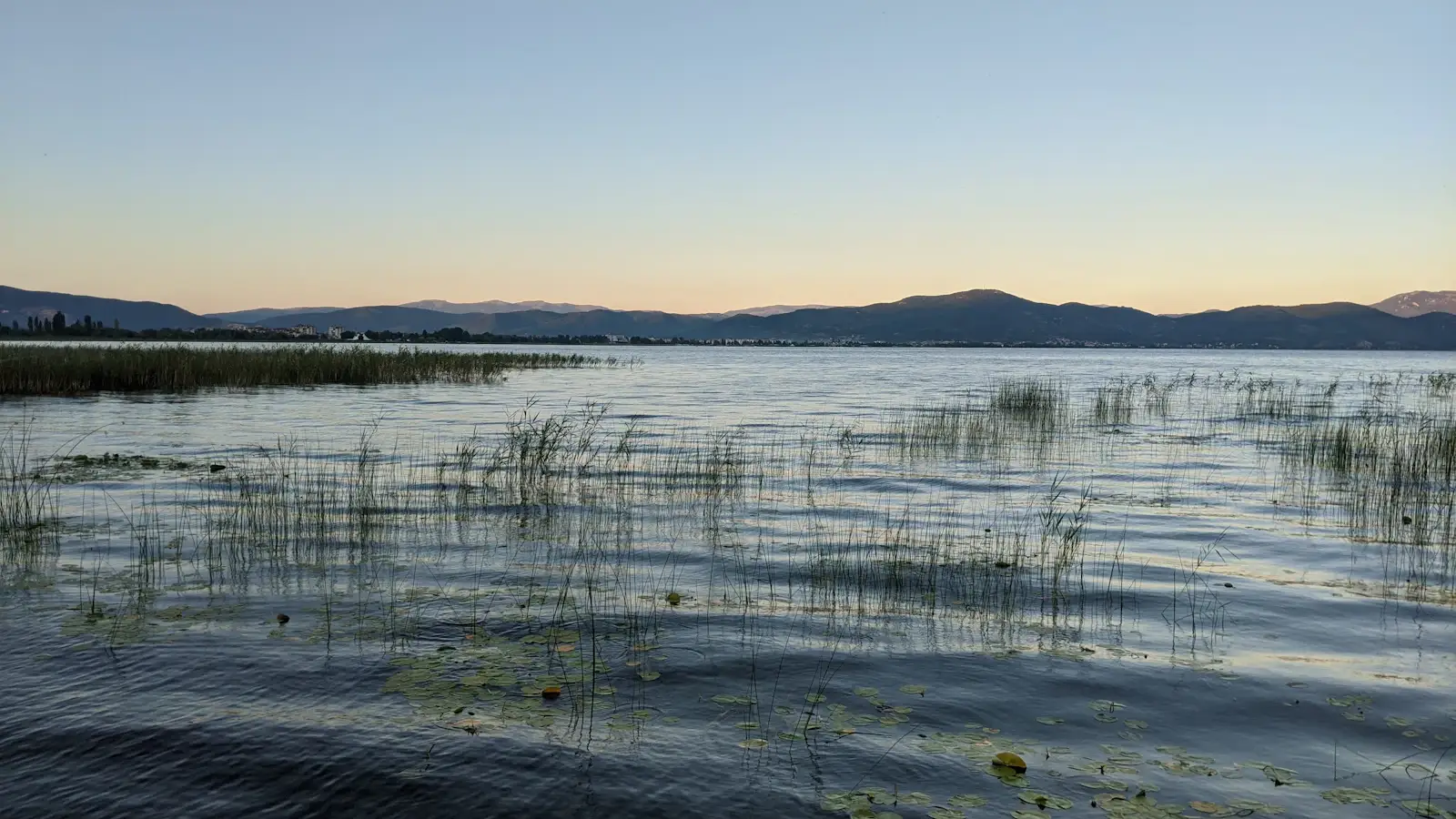
Somewhere around my third plate of trout on the Ohrid waterfront, watching the light go gold over water so clear you could see the lakebed twenty feet down, I remember thinking: why doesn’t everyone talk about this place? Lake Ohrid is one of the oldest lakes on Earth — geologists put it at somewhere between one and two million years old, ancient enough to have evolved its own unique species found nowhere else — and it sits shared between North Macedonia and Albania, ringed by mountains, with a UNESCO World Heritage old town on its eastern shore that somehow still feels wonderfully uncrowded compared to the Croatian coast a few hundred kilometres away. This is a full guide to doing Lake Ohrid properly: which airport to use, how to get around (and why you don’t strictly need a car here, though it helps), and a stop-by-stop plan that takes you around both the Macedonian and Albanian shores.
Which Airport to Fly Into for Lake Ohrid
You have two genuinely good options here, and which one you pick mostly comes down to your flight connections and whether you want to start on the Macedonian or Albanian side of the lake.
- Ohrid “St. Paul the Apostle” Airport (OHD) sits right on the lake, about 10 km from Ohrid old town — the most direct option if you can find a flight into it. It’s small, with mostly seasonal charter and low-cost routes from Western Europe in summer, thinner in winter.
- Skopje “Alexander the Great” Airport (SKP), North Macedonia’s main international airport, has far better year-round connectivity (Wizz Air, Turkish Airlines, Lufthansa and others run regular routes), and it’s about a 2.5 to 3-hour drive southwest to Ohrid. This is what I’d recommend for most travelers, since Ohrid’s own airport connections can be sparse outside peak summer.
If you’re planning to combine this trip with Albania (which I’d genuinely encourage — more on that below), a third option is flying into Tirana International Airport (TIA) and driving northeast about 3.5 hours to reach the Albanian side of the lake at Pogradec, then crossing into North Macedonia from there. This works well if you’re doing a longer loop through Albania first.
Do You Need a Rental Car at Lake Ohrid?
This is one of the few places in this Balkans series where I’d say a car is genuinely optional rather than essential, and it depends entirely on how deep you want to go.
Without a car
Ohrid town itself is fully walkable, and local buses plus a lively minibus network cover the short hop to Sveti Naum Monastery (about 40 minutes down the lakeshore) and the nearby beach villages. Boat trips across and along the lake are widely available and don’t require you to drive anywhere. If your plan is “base in Ohrid, do day trips by boat and local bus,” you really don’t need to rent.
With a car
Where a car earns its keep is if you want to circle the whole lake, cross into Albania to see the lake from the western shore around Pogradec, or detour up into the mountains above Ohrid for the less-visited viewpoints. The road connections here are thinner than in Croatia or Montenegro — buses across the border into Albania exist but run on sparse schedules, and having your own wheels turns a full lake circuit from “theoretically possible but painful” into a genuinely great day.
My honest recommendation: rent a car in Skopje when you land (all the major agencies — Sixt, Europcar, local operator Avis Macedonia — have airport counters), drive to Ohrid, and use it for the full lake loop into Albania. Return it either in Ohrid if the agency allows a one-way drop (confirm this and any drop fee ahead of time) or drive back to Skopje at the end.
The Full Lake Ohrid Itinerary, Stop by Stop
Day 1: Arrival and Ohrid Old Town
Whether you land at OHD or drive down from Skopje, get settled in Ohrid town and spend your first afternoon and evening on foot exploring the old town, which climbs a hill above the lake in a tangle of Ottoman-era wooden houses and Byzantine churches.
- Walk up to Samuel’s Fortress, the medieval citadel crowning the old town, for your first proper view over the lake, the red-tiled rooftops below, and the mountains of Albania across the water.
- Visit the Church of Sveti Jovan at Kaneo, the single most photographed spot in North Macedonia — a tiny stone Byzantine church perched directly on a cliff edge above the lake. Go for sunset if you can; the light on the water behind the church is extraordinary.
- Wander down through the old bazaar and along the lakefront promenade, where you can watch the local rowing clubs and fishing boats come in.
- See the Ancient Theatre, a genuinely well-preserved Hellenistic-era amphitheater tucked into the old town, still used for performances in summer.
Day 2: Plaőnik and the Old Town Churches
Ohrid was once said to have 365 churches, one for every day of the year — an exaggeration, but not by as much as you’d think. Spend a second day going deeper into the religious and archaeological sites that make this a UNESCO World Heritage Site for both its natural and cultural significance.
- Visit Plaőnik, the site of the Church of Sveti Kliment and Sveti Pantelejmon, an important early Slavic center of learning founded in the 9th century, with active archaeological excavations ongoing around the reconstructed church.
- Stop at the National Workshop for Handmade Paper nearby for a look at traditional papermaking, if you enjoy small craft museums.
- Browse the old bazaar for Ohrid pearls — the town’s famous (and slightly mysterious, the exact production method is a closely guarded local secret) handmade pearls, sold in small family-run shops along the main pedestrian street.
- Swim at one of the town beaches in the afternoon — Gradska Plaža right in town is convenient, though the water gets clearer and quieter the further out of town you go.
Day 3: Sveti Naum Monastery and the Lake’s Southern Shore
This is the essential day trip from Ohrid, and I’d rank it among the best half-days in the whole Balkans region.
- Get to Sveti Naum either by the scenic hour-long boat ride down the lake from Ohrid’s harbor (the classic, unhurried way to do it, and honestly worth doing even though the bus is faster) or by minibus/car along the lakeshore road, about 40 minutes.
- Visit the monastery itself, founded in 905 AD by Sveti Naum, a disciple of the Slavic missionary saints Cyril and Methodius. The church interior has striking, slightly eerie frescoes, and the monastery’s peacocks wander the grounds freely.
- Walk to the natural springs just behind the monastery, where the Crn Drim river’s source bubbles up through the ground into small, impossibly clear pools — you can hire a little rowboat to paddle out over the springs and watch the water welling up beneath you.
- Have lunch lakeside at one of the restaurants near the springs — fresh Ohrid trout (pastrmka), a protected local species unique to the lake, is the thing to order everywhere around here, though note it’s a protected species and some restaurants serve farmed alternatives, so ask.
Day 4: Crossing into Albania — Pogradec and the Western Shore
From Sveti Naum, the North Macedonia–Albania border crossing is just a couple of kilometres further south, making it a natural continuation rather than a backtrack. This is the border-hop that makes Lake Ohrid such a great pick for this kind of trip.
- Cross at the Sveti Naum/Qafë Thanë border post, one of the more relaxed crossings in the region — expect a straightforward passport check, busier on summer weekends.
- Drive or bus to Pogradec, the main lakeside town on the Albanian side, about 20–30 minutes from the border. It has a completely different, more low-key character than Ohrid town — a long lakefront promenade, good grilled fish restaurants, and far fewer tourists.
- Walk the Pogradec waterfront in the late afternoon, when locals come out for the evening xhiro (the Albanian version of the passeggiata stroll) along the lake.
- Consider a stop in Lin, a small village on a peninsula jutting into the lake between Pogradec and the border, with its own set of early Christian mosaics and a much quieter, more local feel.
If your visa and schedule allow it, Albania rewards pushing further — Tirana is about 3.5 hours west, and the Albanian Riviera along the southern coast is a whole other trip’s worth of coastline. But even a single day across the border to Pogradec gives you a genuinely different perspective on the same lake, and it’s worth doing even if you turn back to Ohrid the same evening.
Day 5: Galičica National Park and the Mountain Viewpoints
For your final day, head up into the mountains that separate Lake Ohrid from its smaller, wilder neighbor, Lake Prespa.
- Drive up into Galičica National Park, on the ridge between the two lakes. The road up from Ohrid climbs quickly, with pull-offs offering views back down over Ohrid and, from the right vantage points near the top, both lakes visible at once — a genuinely rare sight.
- Stop at the main viewpoint (Vidikovec) for photos — this is the spot locals and photographers alike consider the definitive Ohrid-and-Prespa panorama.
- Descend the other side to Lake Prespa if you have time, a quieter, higher-altitude lake with its own beaches and a much more rural, unhurried feel than Ohrid.
- Return to Ohrid for a final evening on the lakefront, ideally with one last plate of trout and a glass of local Vranec red wine.
Navigating Ohrid and the Lake: Practical Notes
- Ohrid’s old town is steep and cobbled — comfortable shoes matter more than style points here.
- The lake boat trips to Sveti Naum run on a loose seasonal schedule; in summer they’re frequent, in shoulder season check departure times at the harbor kiosk the morning of.
- Border crossings into Albania at Sveti Naum/Qafë Thanë and at the other main crossing near Struga are generally quick outside peak summer weekends, but always carry your passport (not just an ID card) even for what feels like a short hop.
- North Macedonia uses the Macedonian denar; Albania uses the lek — neither is the Euro, so budget for currency exchange or carry a card that doesn’t charge foreign transaction fees.
- Fuel up in Ohrid before crossing into Albania if you’re driving — prices and station availability vary and it’s one less thing to think about mid-trip.
Where to Eat Around Lake Ohrid
- Letna Bavča Kaneo, right by the Sveti Jovan church, is the classic spot for lake-view trout and a sunset drink.
- Restaurant Antiko, tucked into the old town, does traditional Macedonian dishes in a cozy, family-run setting away from the lakefront crowds.
- Near Sveti Naum, any of the small lakeside restaurants by the springs serve fresh trout with a view of the rowboats drifting over the clear water — you can’t really go wrong picking whichever has an open table.
- In Pogradec on the Albanian side, look for grilled koran (a local lake fish similar to trout) at one of the waterfront grills along the promenade.
A Note on Local Food Beyond the Restaurant Guides
Ohrid’s old bazaar is worth grazing through slowly rather than just walking past on your way to the fortress. Small stalls sell dried Ohrid trout, local honey, and a fantastic range of dried fruit and nuts, and it’s common for stallholders to offer a taste before you commit to buying. In the villages around the lake, particularly toward Sveti Naum and along the road to the Albanian border, keep an eye out for small roadside stands selling homemade rakija and ajvar (a roasted red pepper relish that’s a staple across the whole Balkans region) — prices are a fraction of what you’d pay in a tourist shop, and the quality is usually better too, since it’s made in small batches for the family and neighbors first.
On the Albanian side in Pogradec, the evening fish grills that set up along the promenade as the sun goes down are some of the best value eating on this entire route — simple, fresh, and priced for locals rather than tourists, since relatively few foreign visitors make it across the border compared to how many pass through Ohrid itself. If you only do one thing differently from a typical Ohrid visit, let it be crossing for that evening meal in Pogradec.
Best Time of Year for Lake Ohrid
June and September are ideal — warm enough to swim in the lake (which is genuinely refreshing rather than cold, thanks to its depth moderating the temperature), without the peak-July-August crowds that fill Ohrid’s beaches with domestic tourists from across the region on their summer holidays. July does bring the Ohrid Summer Festival, a long-running program of classical music and opera performances in atmospheric venues around the old town, which is worth timing your visit around if that appeals, even with the extra crowds it brings.
Ticket and Booking Links
- GetYourGuide’s Ohrid listings for organized boat trips to Sveti Naum, old town walking tours, and day trips into Albania if you’d rather not self-drive the border crossing.
- Viator’s Ohrid tour listings for similar options plus full-day Galičica and Lake Prespa excursions.
- Rome2rio’s Skopje-to-Ohrid route planner for current bus and shared-taxi options if you’re arriving without a car.
What Makes Lake Ohrid Scientifically Unusual
It’s worth understanding why scientists get so excited about this particular body of water, because it changes how you look at it once you know. Most lakes are geologically short-lived on an evolutionary timescale — glacial lakes, for instance, typically exist for only tens of thousands of years before silting up or draining, nowhere near long enough for meaningful new species to evolve within them. Lake Ohrid, by contrast, has existed continuously in roughly its current form for over a million years, possibly closer to two million depending on which geological estimates you trust, making it one of a small handful of the world’s oldest lakes alongside places like Lake Baikal and Lake Tanganyika. That kind of long, stable timeframe is exactly what’s needed for a phenomenon called adaptive radiation, where isolated populations slowly evolve into entirely new species suited to specific tiny niches within the lake — different depths, different substrates, different food sources — resulting in the roughly 200-plus endemic species found nowhere else on Earth that now call the lake home, from a unique trout species and a range of endemic sponges to numerous types of snails and amphipods that specialist biologists travel here specifically to study.
This scientific significance is a big part of why the lake’s UNESCO designation is as much about its natural heritage as its cultural one, and it’s also why conservation matters so much here — pollution, invasive species, and unregulated development all pose a genuinely outsized risk to a lake that took over a million years to build up its current biodiversity and would recover, if damaged, on a timescale far longer than a human lifetime.
Combining Lake Ohrid With the Rest of the Balkans
Lake Ohrid sits at a genuinely useful crossroads for a longer border-hopping trip: North Macedonia to the east, Albania to the west and south (with the Albanian Riviera and Tirana both reachable in a few hours), and Kosovo to the north via Skopje if you want to extend even further. If you’re building a longer loop, I’d suggest flying into Skopje, doing Lake Ohrid as described here, continuing into Albania toward the Riviera and Tirana, and flying home out of Tirana — an open-jaw itinerary that lets you see three countries without ever backtracking.
A Short History Worth Knowing Before You Go
Lake Ohrid’s significance goes well beyond scenery. In the 9th century, the town became one of the most important centers of Slavic literacy and Christianity in Europe, when Saints Cyril and Methodius’ disciples — chief among them Sveti Kliment and Sveti Naum — established a monastery and school here that helped develop and spread the Glagolitic and early Cyrillic alphabets across the Slavic world. That’s a genuinely enormous cultural legacy for a small lakeside town, and it’s a large part of why UNESCO’s World Heritage listing for Ohrid covers both the natural lake and the cultural sites around it as a single combined designation, one of a relatively small number of “mixed” UNESCO sites in Europe. The lake itself is even older in a different sense — as one of the world’s oldest continuously existing lakes, it’s a rare freshwater refuge where evolution has had unusually long, stable stretches of time to work, producing over 200 endemic species found nowhere else on Earth, from a unique trout species to various snails and sponges that biologists travel here specifically to study.
The town’s more recent history includes periods under Byzantine, Bulgarian, Serbian, and Ottoman rule before becoming part of Yugoslavia and eventually independent North Macedonia in 1991. You can trace a lot of this layered history just by looking at the architecture as you walk uphill through the old town — Ottoman-era wooden houses with overhanging upper floors give way to Byzantine church foundations, which sit near even older Hellenistic and Roman ruins around the Ancient Theatre.
Where to Stay Around the Lake
Ohrid Old Town
Staying in the old town itself puts you within walking distance of everything — Samuel’s Fortress, Sveti Jovan at Kaneo, the bazaar — though the steep, cobbled streets mean you’ll want to pack light if you’re hauling luggage uphill. Small family-run guesthouses here tend to be excellent value and often include a home-cooked breakfast with a lake view.
Along the lakefront toward Gradska Plaža
If you’d rather be closer to the water for swimming and don’t mind a short walk or taxi into the old town proper, the stretch of lakefront hotels and apartments near Gradska Plaža offers easier access and often better rates than the historic core.
Pogradec, Albania
If you’re spending a night on the Albanian side, Pogradec has a growing number of good-value lakefront guesthouses and small hotels, generally cheaper than equivalent Ohrid accommodation, with the bonus of watching the sunset light hit the Macedonian mountains across the water instead of the other way around.
What This Trip Costs, Roughly
Lake Ohrid is one of the best-value stops in this entire Balkans series — North Macedonia and Albania are both noticeably cheaper than Croatia or even Montenegro. Rough daily budgets per person, splitting costs as a couple:
- Budget/van-life style: €30–50/day covering budget guesthouses, mostly local restaurant meals (which are themselves inexpensive here), and public boat or bus transport.
- Mid-range: €60–100/day covering a comfortable guesthouse or small hotel, regular restaurant meals, a rental car, and entrance fees.
- Comfortable/splurge: €150+/day for the nicer lakefront hotels and private boat trips or guided tours across both sides of the lake.
A currency note: since North Macedonia uses the denar and Albania uses the lek, and neither is the Euro, it’s worth having a card with no foreign transaction fees or withdrawing local cash on each side rather than trying to use Euros directly — some tourist-facing businesses will accept Euros, but you’ll get a worse exchange rate than paying in local currency.
Weather and What to Pack, Month by Month
May: mild and green, good hiking weather in Galičica, lake still cool for swimming but the old town and monastery visits are very comfortable. June: warming quickly, an excellent sweet-spot month with fewer crowds than July–August and a swimmable lake. July–August: warm, busy with regional tourists (Ohrid is a major domestic and regional holiday destination, not just an international one), and the Ohrid Summer Festival brings extra energy — and extra crowds — to the old town. September: my pick for this trip too, warm lake water, dramatically thinner crowds, and the mountain light in Galičica National Park is especially good for photography. Bring a light jacket for lake boat trips even in summer, since the water crossing can be breezy even on hot days.
A Note on Language and Local Etiquette
Macedonian is a South Slavic language written in Cyrillic, which can feel like a bigger leap than Croatia or Montenegro’s Latin-script languages if this is your first stop using that alphabet — but Ohrid’s tourism-facing signage is generally bilingual, and learning to recognize a handful of Cyrillic letters (particularly on menus and street signs) makes a noticeable difference within a day or two. Albanian, spoken once you cross into Pogradec, is a language isolate unrelated to its neighbors, and while a few basic phrases like “faleminderit” (thank you) are appreciated, don’t expect much crossover from anything you might have picked up elsewhere in the Balkans. In both countries, hospitality runs deep and genuine — accepting an offered coffee, rakija, or extra plate of food from a host or shopkeeper is generally the polite move rather than a hard decline, even if you’re not particularly hungry or thirsty at that exact moment; it’s a small gesture that goes a long way toward the kind of warm, unplanned encounters that make slow travel through this region so rewarding.
Practical Notes on the Border Crossing and Getting Around
The Sveti Naum/Qafë Thanë crossing into Albania is one of the more relaxed and scenic border posts in the Balkans — you’ll likely spend more time appreciating the mountain views than waiting in line, except on peak summer weekends when regional traffic (much of it Kosovo and North Macedonia residents heading to the Albanian coast) can back up. If you’re not driving, minibuses do run between Ohrid and Pogradec, though schedules are sparser than you’d find in Croatia or Montenegro — check current times locally rather than relying solely on an app, since schedules shift with the seasons and aren’t always reflected accurately online. English is spoken less consistently here than on the Croatian coast, especially once you’re outside the main tourist areas, so a translation app or a few basic phrases in Macedonian and Albanian will smooth things along nicely.
Photography and Viewpoints Worth Planning Around
The Sveti Jovan at Kaneo church is best photographed either at sunrise, when you’ll likely have it to yourself before the tour groups arrive, or at sunset, when the light comes in low across the lake behind it — both work, but sunrise avoids the crowds that build through the day. From Samuel’s Fortress, the best light for the old town rooftop view is mid-to-late afternoon. In Galičica National Park, the main viewpoint looking down on both Ohrid and Prespa lakes simultaneously is most dramatic in clear morning conditions before any afternoon haze builds up over the water — if you only have one shot at the drive up, go earlier in the day rather than later.
Frequently Asked Questions
Is Lake Ohrid safe and easy for a first Balkans trip?
Yes — North Macedonia and Albania are both safe, welcoming, and increasingly set up for tourism, though infrastructure and English proficiency are a step behind Croatia’s well-trodden coast. That’s part of the appeal if you’re looking for a quieter, less-packaged Balkans experience.
Do I need a visa for North Macedonia or Albania?
Most EU, UK, US, Canadian, and Australian passport holders can enter both countries visa-free for short tourist stays, but requirements do change, so check current rules for your specific passport before booking.
How many days do I really need at Lake Ohrid?
Three full days covers the essentials — old town, Sveti Naum, and a taste of Galičica — but I’d push for five if you can, specifically to include the Albanian crossing to Pogradec, which is genuinely one of the most rewarding and least-expected parts of this whole itinerary.
Is the lake actually safe and clean to swim in?
Yes — Lake Ohrid’s water quality is generally excellent, part of why UNESCO protections exist, and swimming is one of the main summer activities for both locals and visitors. The water is also noticeably clearer than most Adriatic beach towns thanks to the lake’s depth and limited development around much of the shoreline.
Can I do a day trip to Ohrid from Skopje without staying overnight?
It’s possible given the roughly 2.5–3 hour drive each way, but I’d strongly discourage it — you’d spend more time in transit than actually seeing the town, and you’d miss Sveti Naum and any chance at the Albanian border crossing entirely. This is a place that rewards at least a few nights of unhurried time.
A Van-Life Note: Getting Around Without Stress
Lake Ohrid was one of the more relaxed legs of my whole Balkans loop for van travel — campsites exist around the lake, including a few right on the water near Ohrid town and more toward the quieter southern shore near Sveti Naum, and rules around overnight parking are generally more relaxed here than in Croatia, though I’d still always default to a proper site when one’s available rather than assuming informal camping is fine. Crossing into Albania in a foreign-plated vehicle is straightforward at Sveti Naum/Qafë Thanë — just make sure your vehicle’s registration and insurance documents are in the van (or your rental paperwork covers Albania specifically) before you approach the checkpoint, since agents do sometimes ask.
Alternative Day Trips If You Have Extra Time
- Bitola: About 90 minutes northeast of Ohrid, this elegant former Ottoman consular city has a wide pedestrian boulevard (Širok Sokak) lined with Habsburg-era buildings and a genuinely different urban character from the lakeside towns — a good change of pace if you want a city day.
- Lake Prespa in more depth: Rather than just the viewpoint from Galičica, you can drive down to Prespa’s shoreline itself, a much quieter, more rural lake with its own small beaches, apple orchards, and monastery ruins on the shared border area with Albania and Greece.
- Berat, Albania: If your Albanian detour has room to stretch, Berat — the famous “town of a thousand windows,” a UNESCO site in its own right — is roughly 3–4 hours southwest of Pogradec, a bit far for a simple add-on but worth knowing about if you’re continuing deeper into Albania rather than looping back.
- Struga: A pleasant, less-visited lakeside town just northwest of Ohrid, known for its poetry festival and a much quieter, more local waterfront scene, easily combined with the Ohrid-to-border drive as a short stop along the way.
A Quick Packing List for This Route
- Comfortable shoes for the steep, cobbled climb up to Samuel’s Fortress and through the old town.
- A swimsuit and quick-dry towel — you’ll want to swim both at Ohrid’s town beaches and, if you make it to the springs, in the clear pools behind Sveti Naum.
- Cash in both Macedonian denars and, if crossing over, Albanian lek — smaller restaurants and market stalls on both sides often don’t take cards.
- A physical passport, not just a digital copy, for the Albania border crossing.
- A light jacket for the boat trip to Sveti Naum and for the cooler evening air up in Galičica National Park.
- An offline map or downloaded region on Google Maps, since mobile data coverage can be patchy in the mountains and along parts of the rural lakeshore road.
A Story From the Road: The Rowboat at Sveti Naum
I almost skipped the rowboat at Sveti Naum, honestly. It felt like exactly the kind of overpriced tourist add-on I usually avoid — pay a small fee, get rowed out over some springs, take a photo, come back. But the young guy who rowed me out, a university student home for the summer working his family’s boat, turned the whole thing into something else entirely. He cut the oars completely once we were out over the deepest of the spring pools and just let the boat drift, pointing down at where you could actually watch the water welling up from underground through the clear surface, disturbing the sand below in slow, hypnotic pulses. He told me his grandfather had rowed the same stretch of water, and that as a kid he used to think the springs were breathing. Sitting there in dead silence, boat barely rocking, watching a million-year-old lake quite literally being born again out of the ground in front of me — that ten minutes did more to make me understand why this lake is considered sacred ground locally than any plaque or museum display could have.
I’ve thought about that stillness a lot since, especially compared to the more performative, camera-ready stops elsewhere on this Balkans loop. Lake Ohrid doesn’t need to perform for you. It just sits there, ancient and clear and quietly extraordinary, waiting for you to slow down enough to notice.
Useful Resources for Planning
- North Macedonia’s official tourism portal for travel information and event listings across the country.
- Ohrid’s local tourism information site for opening hours and seasonal updates on the old town’s sights and the Ohrid Summer Festival calendar.
- Wikipedia’s overview of Lake Ohrid for background on its geology, endemic species, and UNESCO status.
- Albania’s national tourism site for planning the Pogradec and wider Albanian leg of the trip.
- Rome2rio for checking bus and driving connections between Skopje, Ohrid, and Pogradec.
My Honest Take
Lake Ohrid doesn’t get anywhere near the international attention that Croatia’s coast or even Kotor Bay gets, and I genuinely think that’s a mistake on travelers’ part. This is one of the oldest lakes on the planet, ringed by a UNESCO old town, a 1,000-year-old monastery, and a border crossing into Albania that most people don’t even realize is a same-day option. Take it slow, eat the trout, paddle a rowboat over the springs at Sveti Naum, and cross into Pogradec for an evening just to see the same water from the other side. It’s one of the quieter, more rewarding corners of this whole region, and it won’t stay that quiet forever.
Photo by Kiko Temelkov on Unsplash.