There are faster ways to cross Switzerland. There just isn’t a more beautiful one.
The Glacier Express takes a whole day to travel from Zermatt, at the foot of the Matterhorn, to St. Moritz in the Engadine Valley. It crosses 291 bridges and passes through 91 tunnels, climbing over the roof of the Alps and back down again, and it does all of it slowly, on purpose. In winter, when the mountains are buried in snow and the light turns gold by mid-afternoon, it becomes something close to a moving film.
That’s exactly what we set out to capture in our latest Short. Watch the 60-second journey on the WideSprout YouTube channel, then follow the route below stop by stop, with everything you need to plan the trip yourself.
Morning in Zermatt: Where the Journey Begins
The day starts in Zermatt, a car-free village of dark larch-wood chalets tucked beneath the most famous mountain in Switzerland. On a clear winter morning, the Matterhorn’s peak catches the first sunlight long before the village does. It glows white-gold above the rooftops while the streets are still in blue shadow.
The deep-red panoramic carriages wait at the station, their curved windows sweeping up into the roofline. There’s a small, satisfying ritual to boarding: the rattle of suitcase wheels over the platform, the crunch of packed snow, the soft hum of a train that’s about to take its time.
Tip: Arrive in Zermatt the night before. Mornings here are cold, quiet and beautiful, and you won’t want to spend yours rushing for the train.
Down the Valley: The Train Finds Its Rhythm
Leaving Zermatt, the train follows the Matter Valley downhill beside a cold, dark glacial river. Steep white walls rise on both sides, covered in snow-dusted pines and bare golden larches. Early mist often lingers over the water.
This is when you realise what “slow” means here. The train isn’t in a hurry, so neither are you. Out here, the pace is the point.
The Oberalp Pass: The Roof of the Journey
Somewhere around midday, the train starts to climb in earnest. The trees thin out, then disappear entirely, and you’re crossing the Oberalp Pass. At 2,033 metres above sea level, it’s the highest point of the entire route.
In winter, this is a completely different world. There are no villages and no forests, just endless rounded snowfields, a frozen lake lying flat and white beneath the sky, and wind pulling thin veils of snow across the surface. Through the panoramic windows it feels less like looking at a landscape and more like floating through one.
Tip: Have your camera ready before the climb. The pass reveals itself quickly, and the light up here at midday is brilliantly clear.
Trying (and Failing) to Photograph It
Coming down from the pass, the peaks start gliding past the window one after another. You’ll reach for your camera constantly, and you’ll quickly discover that none of your photos come close to what you’re seeing.
That’s not a reason to stop, but it is a reason to occasionally put the camera down. Some of the best moments on this train are the ones you simply watch.
Photography tips for the Glacier Express
- Shoot close to the glass, with your lens nearly touching it, to cut reflections from inside the carriage.
- Wear dark clothing so you don’t reflect in the window.
- Use a fast shutter speed; the train is slow, but vibrations add up.
- Winter light is low, so the afternoon stretch is the warmest and most flattering.
The Landwasser Viaduct: The Icon of the Route
If there’s one image that defines the Glacier Express, it’s this one.
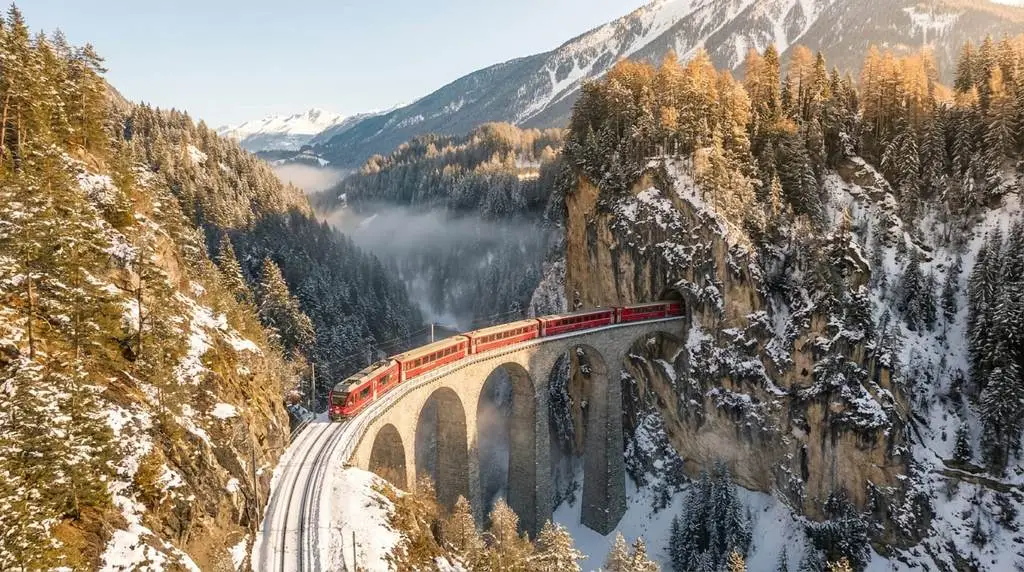
In the Albula region of Graubünden, the train curves out onto the Landwasser Viaduct: six slender stone arches rising about 65 metres above a deep, forested gorge. At the far end, the bridge doesn’t lead to a hillside. It runs straight into a tunnel cut into a sheer cliff face.
From inside the train, the curve of the viaduct means you can sometimes see the front carriages ahead of you, disappearing into the mountain. With snow on the pines and low afternoon sun on the stone, it’s one of the most extraordinary pieces of railway engineering in the world, and it’s over in seconds, so pay attention.
Golden Hour in the Engadine
By late afternoon, the train rolls into the wide, open Engadine Valley. The mountains here are broader and softer, the valley is wide and white, and the light turns gold and then peach.
This is the time for a hot chocolate at your seat, the landscape sliding past, and the realisation that you’ve stopped checking the time. After hours of mountains, gorges and passes, the Engadine feels like a slow exhale before the finish.

Sunset in St. Moritz
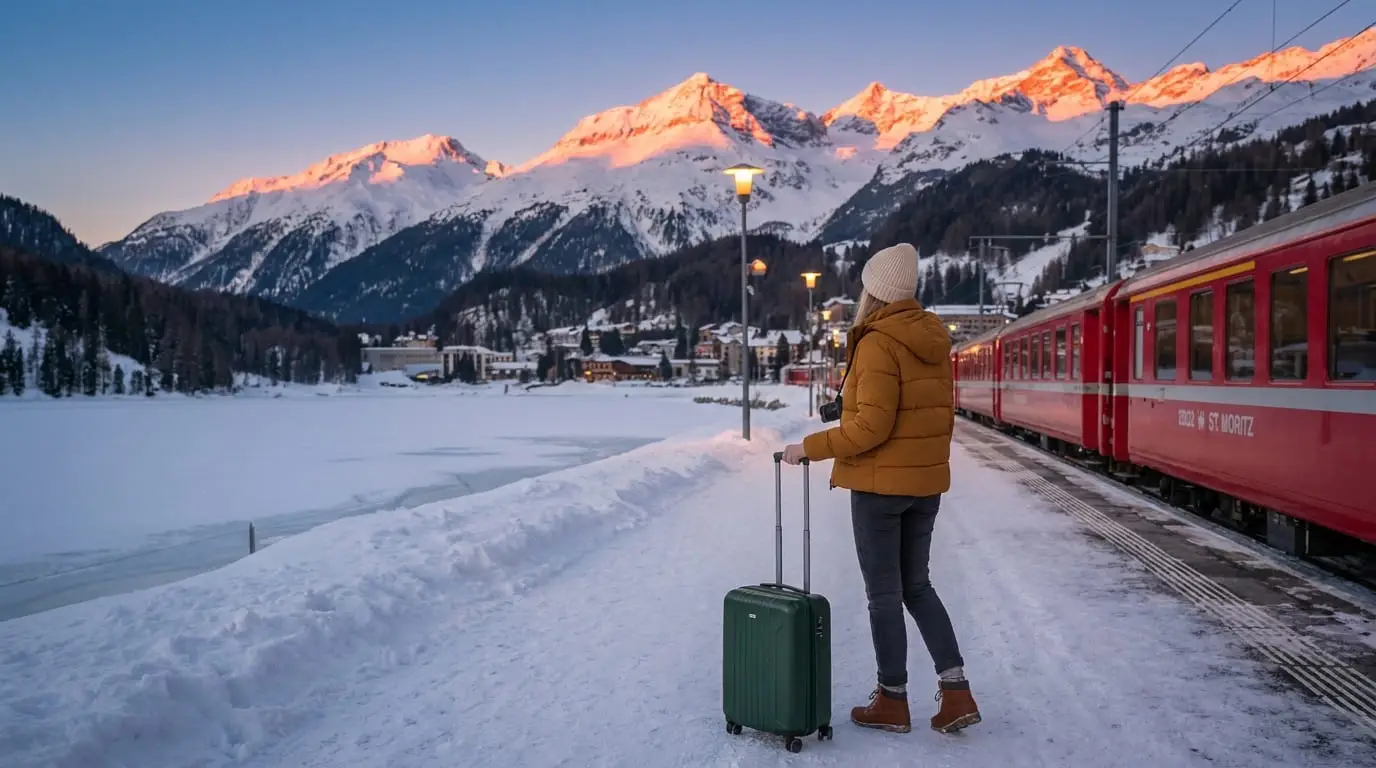
The journey ends in St. Moritz, beside its lake, which in winter lies frozen and covered in snow. If your timing is right, you’ll step onto the platform just as the surrounding peaks turn pink and orange in the evening alpenglow and the station lamps flicker on.
It’s a fitting final scene. You’ve crossed the Alps from one end to the other in a single day, without ever really leaving your seat, and you’ll probably find yourself wanting to do it all again.
Planning Your Own Glacier Express Trip
How long does it take?
The full journey covers about 291 kilometres and takes roughly 8 hours. You can ride it in either direction, but travelling from Zermatt to St. Moritz means a sunset arrival in the Engadine during the shorter winter days.
When does it run?
The train doesn’t run all year. It operates from early January to mid-October and again from mid-December to late December. For snowy winter scenery, aim for the December or January to February windows.
Tickets and seat reservations
There are two parts to the price: a rail ticket (or travel pass) and a seat reservation. The seat reservation is mandatory for every passenger and isn’t covered by travel cards.
- In 2026, reservations cost CHF 54 for both 1st and 2nd class, while Excellence Class costs CHF 540 per person per single journey.
- The Swiss Travel Pass covers the full base fare, so pass holders only pay for the reservation.
- For 1st class and Excellence Class, you also need a 1st class ticket or travel card.
Prices can change, so check the official Glacier Express website before booking.
Book early
The Glacier Express is popular, especially in peak season. Seats can sell out quickly, so booking about three months ahead is strongly recommended.
Pack light
Space on board is limited, and the operator recommends no more than one extra piece of luggage besides your hand luggage.
Want to break up the journey?
Your ticket lets you stop along the route, and Andermatt, Chur and Disentis are popular overnight stops, but you’ll need a new seat reservation for the second leg.
What to wear in winter
Layers. The carriages are warm, but platforms in Zermatt and St. Moritz can be bitterly cold, especially in the morning and at sunset. A down jacket, a warm hat and waterproof boots will keep you comfortable for the moments you step outside.
Is the Glacier Express Worth It?
If you want to get from Zermatt to St. Moritz quickly, no. But that was never the point.
The Glacier Express is a day spent watching Switzerland change outside your window: the Matterhorn at sunrise, frozen high passes, soaring stone viaducts and a golden valley at dusk. It’s one of the few journeys where the travelling itself is the destination.
Have you ridden the Glacier Express, or is it on your list? Tell us in the comments.