
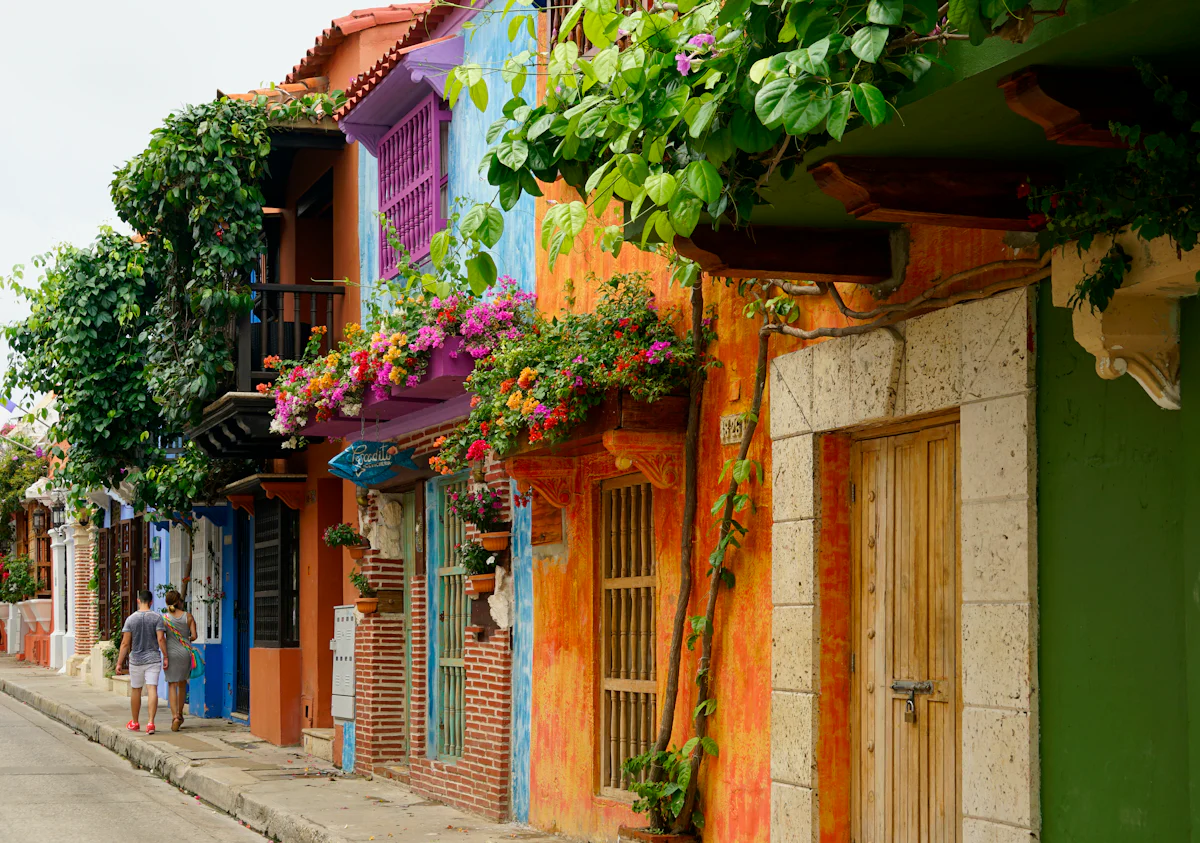
Every Cartagena walled city itinerary should start the same way mine did: standing at the Puerta del Reloj at seven in the morning, before the heat sets in and before the horse-drawn carriages and souvenir stalls fill the plaza, watching the sun turn four hundred years of colonial stone the color of honey. Cartagena is one of those rare places that lives up to the postcards, but it rewards a plan. Show up without one and you’ll spend your first day wandering in circles inside the walls, wondering why everyone told you three days was enough. Show up with a route, and you’ll leave wanting to come back.
Getting There: Which Airport to Land At
Cartagena has its own international airport, which makes this one of the more straightforward Caribbean itineraries to plan. Rafael Núñez International Airport (CTG) sits right on the edge of the city, hugging the coastline just a few minutes from the old town by car. There’s no need to route through Bogotá unless your international carrier requires it — Cartagena receives direct flights from Miami, Fort Lauderdale, Panama City, and a growing list of European hubs during high season, plus frequent domestic connections from Bogotá, Medellín, and Cali if you’re already in the country.
The airport is small enough that you’ll clear immigration and baggage claim quickly, and official yellow taxis line up right outside arrivals with fixed rates posted at a booth inside the terminal — expect to pay roughly 25,000–35,000 Colombian pesos to reach the walled city or Getsemaní, and a bit more to Bocagrande’s high-rise strip. I’d skip negotiating with drivers who approach you before you reach the official taxi stand; the fixed-rate booth is there specifically to avoid that hassle. For a closer look at what to expect on arrival, Cartagena Explorer’s airport guide is a solid practical reference written by a long-time resident.
Getting Around Cartagena: Walk First, Taxi Second, Skip the Rental Car
I’ll say this plainly because I nearly made the mistake myself: do not rent a car for a Cartagena trip that stays within the city. The walled city and Getsemaní are pedestrian mazes of narrow one-way colonial streets never designed for modern traffic, parking is scarce and often informal, and the two neighborhoods you’ll spend 90% of your time in are easily covered on foot in twenty minutes end to end. A car buys you nothing but stress and a parking bill.
What actually works is a mix of walking and metered or app-based taxis. Cartagena’s streets inside the walls are flat, shaded in patches by balconies dripping with bougainvillea, and genuinely enjoyable to wander — this is a city built for getting pleasantly lost in. For trips beyond walking range, such as to Bocagrande, the airport, or the ferry docks for island trips, InDriver and regular taxis are cheap, plentiful, and far less of a headache than trying to self-drive. The only scenario where a rental car earns its keep is a multi-day loop out to Barranquilla, Santa Marta, or the Caribbean coast beyond Cartagena — well outside the scope of a walled-city trip like this one.
Cartagena Walled City Itinerary: Step by Step
This is the order I’d walk it again, front-loaded so the most crowd-sensitive stops happen early or late, with the sweatiest midday hours reserved for museums and lunch breaks indoors.
- Puerta del Reloj and Plaza de los Coches — start at the clock tower gate, the historic main entrance to the walled city, right at sunrise if you can manage it. The plaza just inside was once a slave trading square and is now ringed with cafés; it’s the natural first stop before the crowds arrive.
- Plaza Santo Domingo — a five-minute walk in, home to the leaning bell tower of the Santo Domingo church and Fernando Botero’s famous reclining nude sculpture. Grab a coffee at one of the plaza-side cafés and just sit with it for a while.
- The Gold Museum (Museo del Oro Zenú) — free admission, closed Mondays, and a genuinely worthwhile air-conditioned break covering the pre-Columbian Zenú culture’s goldwork. Good timing for the mid-morning heat.
- Las Bóvedas and the city walls — walk the ramparts along the northern wall toward Las Bóvedas, the old dungeon-turned-souvenir arcade. The wall-top walk here is one of the best free views in the city.
- Getsemaní — cross out of the walls into this formerly rough, now vibrantly muraled neighborhood. Plaza de la Trinidad comes alive in the early evening with street food carts, musicians, and some of the best people-watching in Cartagena.
- Castillo San Felipe de Barajas — dedicate a full morning to this 17th-century fortress, the largest Spanish colonial fortification in the Americas. The tunnel systems alone are worth the entry fee, and the views over the city from the top are unmatched. Official background on the fort’s history is available through Fortificaciones de Cartagena, the body responsible for the site.
- Sunset on the walls near Café del Mar — end a walled-city day back on the ramparts near Baluarte de Santo Domingo as the sky over the Caribbean turns orange. It’s touristy, it’s crowded, and it’s still worth it once.
- Islas del Rosario day trip — set aside one full day for this coral-reef archipelago about an hour offshore by boat. Clear water, mangrove channels, and a genuinely different pace from the city.
For more first-hand detail on several of these stops, including timing and crowd-avoidance tips, Destinationless Travel’s guide to the Old City of Cartagena is worth reading before you go — it’s where I confirmed a few of my own timing choices before landing.
Where to Eat: Real Restaurants Worth Planning Around
Cartagena’s food scene punches well above its size, and a few spots are worth building a meal schedule around rather than leaving to chance.
- La Cevichería — the city’s most famous ceviche counter, tucked into Plaza San Diego, serving a coconut-milk-based ceviche unlike anything you’ll find outside Colombia’s Caribbean coast. Arrive by 3pm or plan on a long wait; it does not take reservations for walk-ins during peak hours.
- Carmen — contemporary Colombian cuisine in a beautifully restored colonial courtyard, consistently ranked among the country’s best tables. Book ahead for dinner, especially on weekends.
- Alma — the fine-dining restaurant at Hotel Casa San Agustín, set around a candlelit courtyard with a well-regarded tasting menu built on Caribbean coast ingredients. A good choice for a splurge night.
For a broader overview of the destination and its culture beyond the plate, Colombia’s national tourism board maintains a solid official Cartagena de Indias destination page, useful for checking current events, festival dates, and safety notices before you travel.
Booking Tickets and Tours
A few of Cartagena’s best experiences are worth pre-booking, both to skip lines and to lock in availability during high season (December–March and July–August):
- Castillo San Felipe de Barajas: entry tickets and guided tours can be booked ahead through GetYourGuide, which is worth it for the included historical context — the tunnels are not well signed on their own.
- Islas del Rosario: full-day boat tours with snorkeling and beach club stops can be booked through GetYourGuide or Viator; both offer free cancellation windows, which is useful given how weather-dependent the crossing can be.
- Walking tours of the walled city: a guided historical walk on your first morning pays for itself in context — you’ll understand what you’re looking at for the rest of the trip rather than retroactively reading plaques.
Practical Tips for Visiting Cartagena
- Weather and timing: Cartagena is hot and humid year-round, with the least rain from December through March. If heat bothers you, plan walled-city walking for early morning and after 4pm, and reserve midday for museums, hotel pools, or the Islas del Rosario boat where the sea breeze helps.
- What to pack: lightweight, breathable clothing, a hat, reef-safe sunscreen (required for most Rosario Islands tours), and comfortable walking sandals rather than sneakers — the cobblestones get hot and the humidity makes closed shoes miserable.
- Money: cards are widely accepted in the walled city and Getsemaní, but carry small-denomination pesos for the Islas del Rosario, street food, and tips, where cash is still king.
- Emeralds: Colombia is a major emerald source and Cartagena’s shops sell them aggressively. Buy only from established jewelers with certificates of authenticity, never from street vendors, however good the story.
- Safety: the walled city and Getsemaní are well-policed and tourist-friendly, but standard city awareness applies at night, particularly around the edges of Getsemaní after midnight.
Three full days is the minimum I’d budget for this itinerary, and four gives you breathing room for a slower Islas del Rosario day and a proper Getsemaní evening without rushing back for an early flight. Cartagena is not a city that needs embellishing — walk it at the right hours, eat where the locals still eat, and it does the rest of the work itself.
Photo by Ricardo Gomez Angel on Unsplash.