
Some winter days in central Switzerland begin in grey. A lid of low cloud settles over Lucerne, the lake turns the colour of pewter, and the mountains you came to see seem to vanish. On those days there is one small journey that feels almost like a magic trick: a boat across Lake Lucerne, a red cogwheel train up the slopes of Mount Rigi, and a summit that sits above the clouds in full winter sunshine. This is the story behind our latest cinematic travel film, and a practical guide to making the trip yourself.
Morning in Lucerne: the arrival
Start at the Chapel Bridge (Kapellbrücke), the covered wooden footbridge that angles across the River Reuss in the heart of Lucerne’s old town. It dates back to the 14th century and is often described as the oldest covered wooden bridge in Europe, although much of it had to be rebuilt after a fire in 1993. On a misty January morning, the painted gable panels overhead, the octagonal stone Water Tower and the still river create a quiet, almost monochrome scene. Snow may dust the rooftops, and on a good morning the white shoulder of Mount Pilatus appears and disappears through the haze.
From the bridge it is only a few minutes’ walk to the lakefront piers beside Lucerne’s main station, where the boats of the Lake Lucerne Navigation Company (SGV) leave for Vitznau.
Across the lake: the journey
The crossing to Vitznau takes roughly an hour, depending on the service and the number of stops. In winter most of the historic paddle steamers are resting, so you will usually travel on one of the motor vessels, but the view is just as good. The lake stretches in long arms between steep, forested ridges, lakeside villages such as Weggis slide past on the shore, and on a foggy day the mist hangs just above the water so the far shores appear as soft grey silhouettes.
Take a spot on the open deck for at least part of the ride. The cold air, the churn of the wake and the hush of the mountains around you are a big part of the experience.
Vitznau: discovering Europe’s first mountain railway
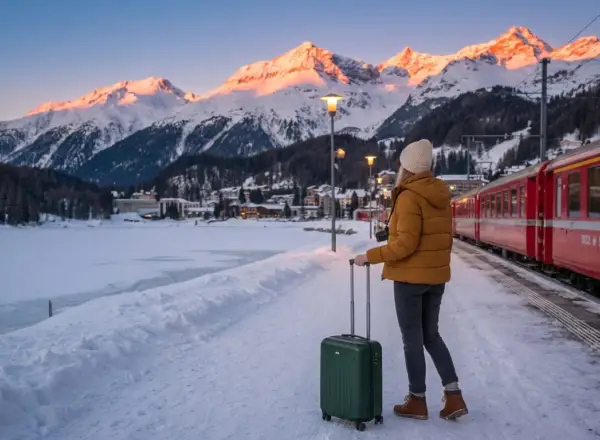
Vitznau sits at the foot of Mount Rigi, and right beside the boat pier is the lower station of the Vitznau–Rigi railway. When it opened on 21 May 1871, it became the first mountain railway in Europe. Today its red cogwheel trains climb about 7 kilometres from the lakeshore at 439 metres to Rigi Kulm station, on gradients of up to 25 percent. The ride takes around half an hour.
Watching the train push away from the lake and up into the snow-covered forest is one of those moments that makes the whole trip click: the lake below, the mountain above, and a toothed rack rail doing the hard work in between.
Breaking through the clouds: the experience
This is the part that makes a winter Rigi trip unforgettable. On many days between late autumn and late winter, cold air gets trapped in the lowlands beneath a layer of warmer air, creating what the Swiss call a Nebelmeer, or sea of fog. From below it is simply a dull, grey day. As the train climbs, however, the light begins to change. The fog thins, the fir trees turn white with frost, and then, often somewhere around Rigi Kaltbad, you break through the top of the cloud into blue sky and sharp sunshine.
Sit on the lake side of the carriage, keep your camera ready and watch the windows. The moment the grey turns to gold is worth the fare by itself.
Rigi Kulm: the epic landscape
Rigi Kulm, the summit, stands at about 1,798 metres. It is far from Switzerland’s highest peak, but its position, rising almost on its own between Lake Lucerne, Lake Zug and Lake Lauerz, gives it a panorama that earned Rigi the nickname “Queen of the Mountains”. On a clear day the view runs along a long chain of Alpine peaks, with Pilatus close by and the high summits of the Bernese Oberland on the horizon.
When the sea of fog is in, the lakes and lowlands disappear entirely. What remains is a flat white ocean of cloud with mountain tops rising out of it like islands. Walk the short path from the station up to the summit viewpoint and give yourself time to simply stand there and take it in.
The small details
A winter summit is as much about small comforts as big views. There is a hotel with a restaurant just below the top, so a hot drink warming your hands while you watch the clouds move is easy to arrange. Notice the details: frost feathers on the wooden railings, the crunch of snow on the path, the squeak of boots on packed ice and the way the low winter sun catches every crystal.
A quiet moment
Find a bench, put the camera down for a while and let the afternoon slow down. Winter days are short, and the light changes quickly as the sun sinks. The shadows of the peaks begin to stretch across the cloud tops, and the whole scene turns softer and warmer by the minute.
Sunset above the clouds: the final reveal
If you can, stay for sunset. As the sun drops, the sea of fog glows pink and orange, the snowy summits catch the last light, and the lowlands under the cloud stay completely hidden. It is a quiet, almost unreal ending to a day that began in grey. Check the timetable before you go, as winter trains down from Rigi Kulm run less often, and plan your descent so you are not rushing for the last connection.
If you would like to see this journey as a short cinematic film, watch it on the WideSprout YouTube channel.
Planning your winter trip to Mount Rigi
How to get there
- By boat and cogwheel train: take an SGV boat from Lucerne to Vitznau (about an hour), then the Vitznau–Rigi cogwheel train to Rigi Kulm (about 30 minutes).
- By cable car: from Weggis, a cable car climbs to Rigi Kaltbad, where you can join the cogwheel train to the summit.
- From the other side: a second cogwheel line runs up from Arth-Goldau, a mainline rail hub between Lucerne and Zug. Going up one way and down the other makes a satisfying loop.
When to go
The Rigi railways run all year. For snowy scenery, aim for December to February; for the best chance of a sea of fog, late autumn and winter are the classic months. Check the MeteoSwiss forecast and the Rigi webcams the evening before: grey skies forecast for Lucerne combined with sunshine at higher altitude is exactly what you are hoping for. Lake Lucerne boats also sail in winter, but on a reduced timetable, so check departures in advance.
Tickets and prices (2026)
- Rigi day pass: CHF 84 for adults (prices valid from 1 June 2026), covering the Rigi railway network.
- Vitznau–Rigi Kulm: CHF 52 one way or CHF 84 return.
- Swiss Travel Pass and GA: travel on the Rigi railways is included, and regular SGV boat services on Lake Lucerne are covered too.
- Half Fare Card: 50 percent off most Rigi fares.
Prices can change, so confirm current fares on the official Rigi and SGV websites before you travel.
What to wear
Dress as if you were going somewhere much colder than Lucerne. Above the fog the sun can feel warm, but the air is cold, the wind on the summit can bite and paths may be icy. Bring a warm insulated jacket, a thick knit layer, a hat, gloves and waterproof hiking boots with good grip. Sunglasses and sunscreen matter too, because snow and cloud tops reflect a lot of light.
Photo tips
- Sit on the lake side of the cogwheel train on the way up for the best views of the lake and the fog layer.
- Use a wide lens for the sea of fog, and include a person, a railing or a tree to show the scale.
- For sunset, reach the summit at least an hour early and shoot as the colours change, not only at the peak glow.
- Keep spare batteries warm in an inside pocket, because the cold drains them quickly.
Is it worth it?
Yes, especially in winter. Mount Rigi packs a scenic lake crossing, Europe’s first mountain railway and one of the great panoramas of central Switzerland into a single, easy day from Lucerne. On a foggy day it offers something even better: the feeling of climbing out of a grey world into sunshine, and watching the sun set over an ocean of clouds. Few Alpine days give you so much for so little effort.