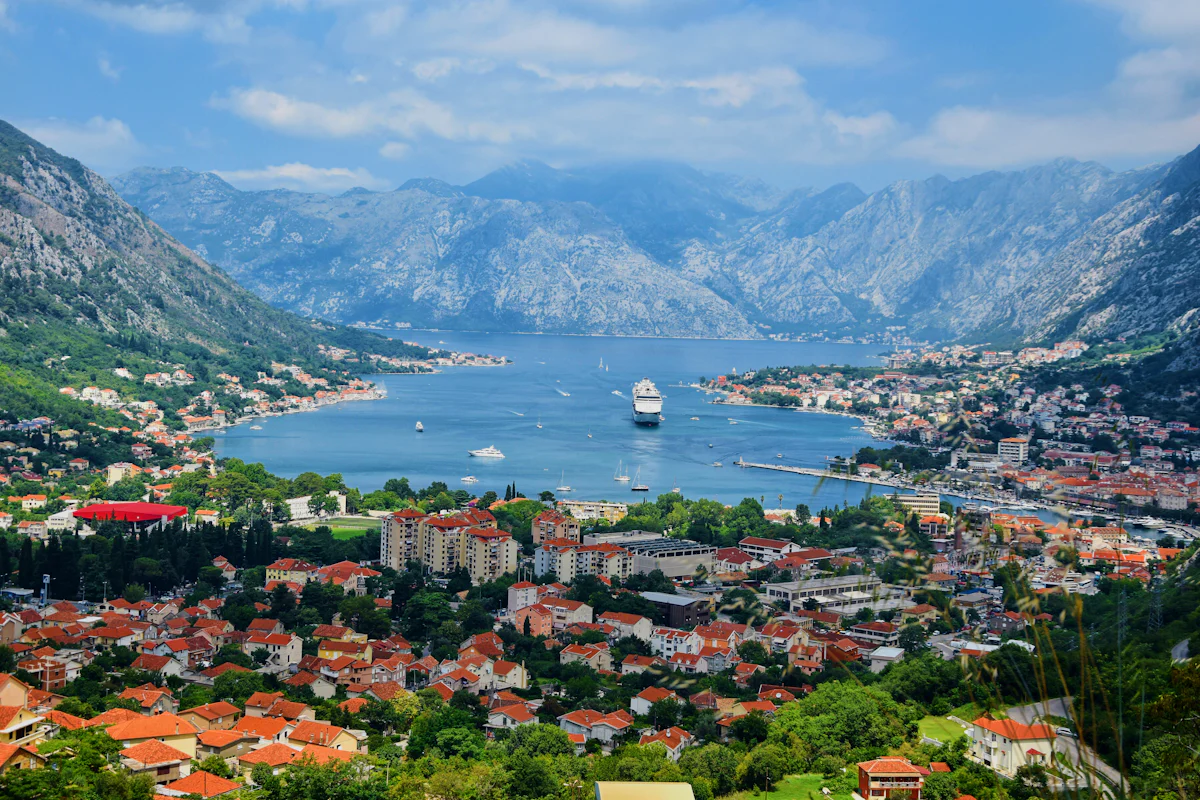
The first time I drove the road around the Bay of Kotor, I nearly put the van in a wall. Not because it’s dangerous exactly, but because the bay keeps doing this thing where it opens up around a bend and you completely forget you’re supposed to be watching the road. Locals call it “Europe’s southernmost fjord,” which isn’t technically accurate — it’s a submerged river canyon, not a glacial fjord — but the description sticks because nothing else in the Adriatic looks like this: sheer grey mountains dropping straight into still, dark-green water, with a string of stone villages clinging to the narrow shoreline between them. This is a guide to doing Kotor Bay properly, as the centerpiece of a Montenegro visit or as a leg of a longer Balkans border-hop, with a full day-by-day plan, real transport advice, and the exact places I’d send a friend.
Which Airport to Fly Into for Kotor Bay
The closest and most convenient airport is Tivat Airport (TIV), sitting right on the bay itself, about 20–25 minutes’ drive from Kotor Old Town. It’s small and mostly handles seasonal European routes (heavy in summer, much thinner in winter), so depending on when you’re traveling and where you’re flying from, you may find better connections into Podgorica Airport (TGD), Montenegro’s larger capital-city airport, about an hour to 90 minutes from Kotor depending on traffic through the Sozina Tunnel.
A third option worth knowing about, especially if you’re combining this trip with Dubrovnik and the Dalmatian Coast (a very natural pairing — see my companion guide to that route), is flying into Dubrovnik Airport (DBV) in Croatia and driving south across the border, about 1.5–2 hours to Kotor depending on the border queue. This is actually what I did, treating Kotor as the second half of a two-country loop, and I’d recommend it if your dates allow — Dubrovnik generally has far more international flight options than Tivat or Podgorica.
- Best for a Montenegro-only trip: Fly into Tivat (TIV) in summer, or Podgorica (TGD) if Tivat’s seasonal routes don’t match your dates.
- Best for a Balkans border-hop: Fly into Dubrovnik (DBV), drive or bus south across the Croatia–Montenegro border at Karasovići/Debeli Brijeg.
Do You Need a Rental Car for Kotor Bay?
Yes — more than almost anywhere else in this region, I’d say a car is essential here, and here’s why. The bay road (the E65/E80) that loops around the entire waterline connecting Tivat, Kotor, Perast, Risan, and Herceg Novi is spectacular but has almost no useful public transport running its full loop on a schedule that suits travelers. Local buses exist between the bigger towns, but they run infrequently, don’t serve most of the tiny villages and viewpoints, and won’t get you up the switchback road to Lovćen National Park or across into the Budva Riviera at your own pace.
Renting a car
Pick up your rental directly at Tivat or Podgorica airport arrivals — both have the usual chain operators (Sixt, Europcar, Hertz) plus cheaper local agencies. If you’re crossing in from Croatia, confirm your rental agreement explicitly covers Montenegro (a non-EU country), since some cross-border insurance clauses exclude it or charge extra — always ask directly before signing.
If you don’t want to drive
It’s still doable without a car, just slower and more town-focused. Local buses and minivans connect Tivat, Kotor, and Budva reasonably well, and boat taxis and organized tours (bookable through GetYourGuide or Viator) cover Perast, Our Lady of the Rocks, and the Lovćen viewpoint without you needing your own wheels. I’d only recommend skipping the rental if you’re planning to base yourself in Kotor Old Town for several days and do day trips by boat and organized tour rather than self-driving the loop.
The Full Kotor Bay Itinerary, Stop by Stop
Here’s the sequence I’d follow for a full, unhurried look at the bay — built as a 5–7 day plan, but compressible to a long weekend if that’s all you’ve got.
Day 1: Arrival and Kotor Old Town
Land at Tivat, pick up your car, and drive the short hop to Kotor. Check in, then spend the afternoon and evening simply wandering — Kotor’s old town is a genuine maze of narrow marble-paved lanes, small squares, and Venetian-era buildings packed inside 4.5 km of medieval walls, all backed dramatically by the sheer face of St. John’s Hill.
- Enter through the Sea Gate on the harbor side, the main entrance, and get oriented at the Square of Arms just inside.
- Visit St. Tryphon’s Cathedral, the Romanesque cathedral at the heart of the old town, dating to 1166.
- Wander without a map for an hour — genuinely the best way to experience Kotor’s tangle of streets, which deliberately confused pirates and invaders for centuries and still confuses GPS apps today.
- Watch the cats. Kotor is famously overrun with beloved street cats, and there’s even a small Cats Museum if you’re into that sort of thing.
Day 2: Climb the City Walls to St. John’s Fortress
This is the single best thing to do in Kotor and one of my favorite viewpoints anywhere in the Balkans. The walls climb almost 1,200 steps up the sheer mountainside behind the old town to the Fortress of St. John (Kaštel Sveti Ivan) at roughly 260 metres above the bay.
- Start very early — by 7am in summer if you can manage it. There’s minimal shade on the climb and it gets brutally hot by mid-morning.
- Buy tickets at the entrance near the Church of Our Lady of Remedy, roughly a third of the way up (also bookable in advance through GetYourGuide to skip the line).
- Take it slow and rest at the switchbacks — the views open up gradually and are worth pausing for at every level, not just the top.
- Reach the summit for a sweeping view down the entire bay, the old town rooftops directly below, and the mountains of Lovćen behind you.
Day 3: Perast and Our Lady of the Rocks
Drive (or take a boat taxi) about 20 minutes northwest along the bay road to Perast, a beautifully preserved baroque village of stone palaces built by Venetian-era sea captains, with almost no modern development to spoil it.
- Walk the single waterfront street of Perast, lined with 17th and 18th-century palazzos, many now boutique hotels or small museums.
- Take the short boat ride out to Our Lady of the Rocks (Gospa od Škrpjela), a man-made islet with a beautiful baroque church, built up over centuries by local sailors dropping stones and sunken ships on the site after a supposed miraculous icon discovery in 1452. Boats leave constantly from the Perast waterfront and the trip plus church visit takes about an hour.
- Climb St. Nicholas’ Church bell tower in Perast itself for a rooftop view over the village and the bay’s inner curve.
- Lunch at a waterfront konoba — Konoba Školji is a reliable, well-reviewed local spot for fresh seafood right on the water.
Day 4: Lovćen National Park and the Serpentine Road
This is the day I’d tell you not to skip, even though it’s more effort than most itineraries bother with. Above Kotor, an old serpentine road (locally called the Kotor Serpentine or the “Ladder of Kotor,” 25 hairpin switchbacks in a few kilometres) climbs to Lovćen National Park, Montenegro’s spiritual heartland and home to the mausoleum of Njegoš, the country’s revered 19th-century prince-bishop and poet.
- Drive the serpentine road slowly — it’s narrow, has no guardrails in places, and is genuinely one of the great drives of the Balkans. Each switchback gives you a new angle on the bay shrinking below you.
- Stop at the marked viewpoints along the way; there are several pull-offs specifically for the view back down over Kotor.
- Visit the Njegoš Mausoleum at the top of Jezerski Vrh peak (1,657m) — a short climb up 461 steps inside the mountain to a black granite structure guarded by two stone eagles, with (weather permitting) a view stretching to both the Adriatic coast and inland toward Montenegro’s mountainous interior on a genuinely clear day.
- Have lunch in Njeguši village on the way back down, famous across Montenegro for its air-dried prosciutto (njeguški pršut) and hard cheese — nearly every small restaurant here serves a version of the same excellent farmhouse plate.
Day 5: Herceg Novi and the Bay’s Northern Shore
Drive the rest of the bay loop northwest to Herceg Novi, the entry town if you’re coming from Croatia, and a pleasant, palm-lined old town with its own fortress and a much less touristy feel than Kotor.
- Wander Herceg Novi’s old town, centered around Belavista Square and the Kanli Kula fortress.
- Ride (or walk) up to Savina Monastery, a working Orthodox monastery in a quiet forested setting above the town.
- Swim at one of the pebble beaches along the Herceg Novi Riviera before heading back around the bay.
Day 6–7: Budva and the Budva Riviera (Optional Extension)
If you have extra days, it’s an easy 30–40 minute drive south from Kotor over a low coastal pass to Budva, Montenegro’s main beach resort town, with a small walled old town of its own and a livelier nightlife scene than Kotor.
- Walk Budva’s old town walls and the citadel at its seaward tip.
- Take the short drive or boat to Sveti Stefan, the iconic islet village connected to the mainland by a narrow sandy isthmus, now an exclusive resort — you can’t walk onto the islet itself unless staying there, but the view from the mainland viewpoint (especially at sunset) is one of the most photographed scenes in Montenegro.
- Continue to Petrovac for a quieter beach day if Budva feels too busy.
Navigating the Bay Road: Practical Driving Notes
The road hugging the Bay of Kotor is narrow, twisting, and often only just wide enough for two cars to pass, especially through Perast and Risan. A few practical notes from actually driving it:
- Distances look short on a map but take much longer than expected — budget close to double what Google Maps suggests, especially in July and August.
- The tunnel-and-ferry shortcut at Verige (the narrowest point of the bay) via the Lepetane–Kamenari car ferry saves real time if you’re crossing from the Tivat side to the Herceg Novi side without looping the whole bay — it runs constantly and you don’t need to book ahead.
- Parking in Kotor old town itself isn’t possible — use the paid lot just outside the walls near the bus station and walk in.
- If you’re crossing from Croatia at the Debeli Brijeg/Karasovići border, expect longer queues in peak summer weekends; mornings are usually faster than afternoons.
- Fuel up before the Lovćen serpentine climb — there are no stations on the mountain road itself.
Where to Eat Around Kotor Bay
- Restaurant Galion, right on the water just outside Kotor’s old town walls, does excellent seafood risotto with a direct view back at the fortifications.
- Konoba Scala Santa, tucked into the old town’s back streets, is a solid, unpretentious choice for traditional Montenegrin dishes like cicvara and grilled fish.
- For the njeguški pršut and cheese plate experience, any small family konoba in Njeguši village will do you right — there isn’t really a “wrong” choice, they’re all working off the same excellent local ingredients.
A Note on Local Food Beyond the Restaurant Guides
Some of the best eating on this route happens outside any formal restaurant at all. Njeguši village, on the way down from Lovćen, is worth a slow wander even beyond the sit-down lunch I mentioned earlier — small farmhouse stalls along the main road sell their own pršut and cheese directly, often with a taste offered before you buy, and the quality varies delightfully little from stall to stall since most families have been curing meat the same way for generations, hung in the same stone smokehouses. If you see a farmhouse with hams visibly hanging in an open shed near the road, that’s usually a sign it’s worth stopping.
Around the bay itself, look for small waterfront grills in Dobrota and Prčanj, quieter villages just outside Kotor proper, serving grilled fish and octopus salad at a fraction of old-town prices, often with a view that rivals anything you’d pay a premium for closer to the walls. As with Croatia, my rule of thumb holds here too: the plainer the menu and the closer to the water without an overt tourist-facing setup, the better the meal usually turns out to be.
Best Time of Year for Kotor Bay
Late May through June, and September through early October, are the sweet spots — warm enough to swim, cool enough to comfortably do the St. John’s Fortress climb and the Lovćen drive without melting. July and August bring cruise ship crowds into Kotor old town in the mornings (several ships often dock at once), which can make the main square genuinely uncomfortable by 10am. If you’re visiting in peak summer, do your old town wandering very early or in the evening and save midday for the beaches or a boat trip out on the bay itself.
Ticket Booking Links for the Main Sights
- Kotor City Walls and St. John’s Fortress tickets — book ahead for summer visits to skip the entrance queue.
- Viator’s Kotor tour listings for organized boat trips to Our Lady of the Rocks, Blue Cave excursions, and Lovćen day tours if you’d rather not self-drive.
- GetByBus for bus tickets between Kotor, Budva, Herceg Novi, and onward to Dubrovnik if you’re not renting a car.
What Makes the Bay of Kotor Geologically Unusual
It’s worth pausing on the “is it a fjord or not” question, because it actually explains why the bay looks the way it does. True fjords are carved by glaciers scouring deep U-shaped valleys that later flood with seawater — think Norway. Kotor Bay formed differently: it’s a submerged karst river canyon, cut over millions of years by fresh water dissolving and eroding the region’s soft limestone bedrock, then flooded by the Adriatic as sea levels rose after the last ice age. The result looks remarkably fjord-like from a distance — steep walls, a narrow winding inlet, deep still water — but the underlying geology is entirely different, and it’s part of why the surrounding mountains have such a distinctive pale, karst-eroded texture rather than the more rounded, glacially-smoothed look of actual fjord country. Locals will still call it a fjord in casual conversation because it’s an easier shorthand for visitors, and honestly I stopped correcting people about a day into my own trip once I understood how little it mattered to the experience of actually being there.
This karst landscape also explains the region’s famous underground cave systems — Lipa Cave, near Cetinje not far from the Lovćen road, is a large, well-developed show cave worth a stop if you enjoy that kind of geology, with guided tours running year-round through chambers formed over hundreds of thousands of years by the same water-and-limestone process that shaped the bay above ground.
Combining Kotor With the Rest of the Balkans
Kotor Bay sits almost perfectly between Dubrovnik to the north and the Albanian border to the south, which makes it a natural midpoint on a longer border-hopping Balkans loop. From Kotor, it’s roughly a 3-hour drive south to the Montenegro–Albania border crossing near Sukobin/Muriqan, opening up the Albanian Riviera and Lake Skadar (shared between the two countries and worth a paddle or boat trip in its own right, home to one of Europe’s largest pelican colonies) as a natural next leg if you’ve got more time on your visa and more road in you.
A Short History of the Bay
The Bay of Kotor’s strategic value — a deep, sheltered, defensible harbor tucked behind a ring of mountains — made it a prize fought over by nearly every Adriatic power for a thousand years. Illyrian tribes, Romans, Byzantines, Serbian medieval kingdoms, the Venetian Republic (which held it longest and left the deepest architectural fingerprint, hence all the palazzos and Venetian lions carved into gates around Kotor and Perast), briefly the Napoleonic French, the Austro-Hungarian Empire, and eventually Yugoslavia all held the bay at different points. Kotor’s fortifications as they stand today are largely a Venetian-era project, built and rebuilt across the 9th through 19th centuries, which is why the walls have such a patchwork, layered feel if you look closely at the stonework as you climb toward St. John’s Fortress.
A 1979 earthquake did serious damage to Kotor’s old town, and much of what you see today was carefully restored afterward with UNESCO involvement, which is part of why Kotor’s old town retains World Heritage status alongside its natural surroundings — the listing specifically recognizes the combination of the fortified town and the dramatic natural setting of the bay together, not the architecture alone.
Where to Stay Around the Bay
Kotor Old Town
Staying inside the walls puts you right in the atmosphere but means noise from bars and restaurants late into summer nights, plus no vehicle access — same trade-off as Dubrovnik. A good middle ground is the Dobrota area just north of the old town along the bay road, a quieter residential stretch with waterfront guesthouses and easy walking or short driving distance into the walls.
Perast
If your budget allows, spending one night in Perast itself rather than just day-tripping there is genuinely worth it — several of the old sea-captain palazzos have been converted into small boutique hotels, and having the village to yourself after the day-trip boats leave in the late afternoon is a completely different, much more peaceful experience.
Budva and Sveti Stefan area
If you’re extending to the Budva Riviera, Budva old town itself gets loud with nightlife in peak summer; Petrovac just south is a quieter, more family-oriented alternative with its own good beaches.
Health, Connectivity, and Money Practicalities
Pharmacies and basic medical care are readily available in Kotor and the larger towns around the bay, though it’s worth having travel insurance that covers Montenegro specifically, since as a non-EU country it sometimes falls outside the automatic coverage of EU-based health insurance or EHIC-style cards. For connectivity, a local SIM card (widely available at kiosks in Tivat and Podgorica airports, or in Kotor itself) is inexpensive and worth picking up on arrival if your home carrier’s Balkans roaming rates are steep, since you’ll want reliable maps and translation access, particularly for the more rural stretches around Lovćen and Njeguši where signage in English thins out. ATMs are common in all the towns on this itinerary, and while card payment is increasingly accepted even in smaller restaurants, I’d still keep a reasonable amount of Euro cash on hand for village stalls, parking machines, and the smaller family-run konobas that make this trip worthwhile.
What This Trip Costs, Roughly
Montenegro sits comfortably below Croatia on cost, using the Euro despite not being an EU member (a quirk of its unilateral adoption of the currency), which keeps budgeting simple even though prices run noticeably lower than across the border. Rough daily budgets per person, splitting costs as a couple:
- Budget/van-life style: €45–70/day for a campsite or budget guesthouse, mostly self-catered or konoba meals, and minimal paid attractions.
- Mid-range: €90–140/day for a comfortable guesthouse, eating out regularly, a rental car, and the main paid sights.
- Comfortable/splurge: €200+/day for boutique stays in Perast or Sveti Stefan-adjacent hotels and private boat charters around the bay.
Weather and What to Pack, Month by Month
Late April through May: mild, green, occasional rain, good for the Lovćen hike and fortress climb without summer heat — bring a light rain layer. June: warming fast, sea becoming swimmable, still relatively quiet before the July surge. July–August: hot and busy, cruise ships stacking up in Kotor’s harbor most mornings, sea at its warmest — plan old town visits for early morning or evening. September into early October: my recommended window here too, warm sea, thinning crowds, and noticeably more comfortable conditions for the St. John’s Fortress climb, which is genuinely tough in full August heat.
A Note on Language and Local Etiquette
Montenegrin is closely related to Serbian, Croatian, and Bosnian, and if you’ve picked up even a few basic phrases from a previous Croatia trip, you’ll find them largely understood here — a friendly “dobar dan” (good day) and “hvala” (thank you) go a long way, as they do across most of this region. English is widely spoken in Kotor and the main tourist towns, less so once you’re up in the villages around Lovćen and Njeguši, where a smile, patience, and a translation app cover most gaps comfortably. One small cultural note: Montenegrins, like much of the wider Balkans, take coffee culture seriously and unhurriedly — don’t be surprised if a “quick coffee” stretches to forty-five minutes of unhurried conversation with whoever’s running the place; it’s considered rude to rush this, and honestly, once you adjust to the pace, it’s one of the nicer parts of traveling through this region.
Safety, Border Crossings, and Practical Notes
Montenegro is safe, welcoming, and well set up for tourism, though it’s worth knowing it’s not an EU member (despite using the Euro), so you will go through a proper passport check crossing in from Croatia or onward to Albania — always keep your passport accessible, not buried in a bag in the boot. If you’re driving a rental car across either border, carry the rental agreement and confirm cross-border coverage before you leave the rental counter; agents at land borders do occasionally ask to see it. Mobile data roaming from EU providers generally does not extend to Montenegro, so check your carrier’s Balkans/rest-of-world rates or grab a local SIM if you’ll need maps and bookings on the go.
Photography and Viewpoints Worth Planning Around
The single best photo of the whole bay, in my opinion, is from roughly two-thirds of the way up the St. John’s Fortress climb, where you get the old town rooftops, the harbor, and the full curve of the inner bay in one frame without the haze that can settle in by midday — go early. On the Lovćen serpentine road, the third and fourth switchbacks from the bottom give the classic “road folding back on itself with the bay below” shot that shows up in most Montenegro tourism photography. In Perast, shoot Our Lady of the Rocks from the village waterfront in the late afternoon, when the light comes from behind you and lights up the islet and its cypress trees directly.
Frequently Asked Questions
Is Kotor too touristy now, like Dubrovnik?
Kotor’s old town does get genuinely crowded when multiple cruise ships dock on the same morning, which happens often in peak summer. But because the bay itself is so large, it’s easy to escape the crowds entirely — Perast, Lovćen, and even parts of the old town in early morning or evening feel nothing like the midday cruise-ship crush.
Can I visit Kotor as a day trip from Dubrovnik instead of staying overnight?
You can, and many tour companies sell exactly this trip, but I’d push back on it gently — the drive alone is around two hours each way with the border crossing, which leaves you with only a few rushed hours actually in Kotor. If you can manage even two nights, you’ll get so much more out of it, particularly the St. John’s Fortress climb, which really needs an early morning start you can’t get on a day-trip bus schedule.
Do I need a visa for Montenegro?
Most EU, UK, US, Canadian, and Australian passport holders can enter Montenegro visa-free for short tourist stays (typically up to 90 days), but rules do shift, so check current requirements for your specific passport before you travel.
Is the St. John’s Fortress climb difficult?
It’s roughly 1,200 uneven stone steps gaining about 260 metres, so it’s a genuine workout rather than a casual stroll — doable for most reasonably fit travelers with a few rest stops, but bring water, wear proper shoes rather than sandals, and avoid the midday heat in summer.
A Van-Life Note: Camping and Overnight Parking Around the Bay
Montenegro is noticeably more relaxed about informal camping and overnight van parking than Croatia, particularly outside the immediate old town areas, though I’d still always ask locally or use a proper campsite where one exists rather than assuming. There are a handful of well-placed campsites around the bay, including options near Dobrota within easy walking distance of Kotor old town, and others further around toward Risan with quieter, more open bay views. If you’re driving up to Lovćen, note that overnighting anywhere within the national park boundaries requires using the designated facilities rather than pulling off the serpentine road itself, both for safety (there’s genuinely no shoulder in places) and because it’s a protected area.
Alternative Day Trips If You Have Extra Time
- Blue Cave and the Luštica Peninsula: A boat trip from Kotor or Tivat out past the bay’s mouth to a sea cave where sunlight refracts through the water to create a striking blue glow — best visited in the morning when the sun angle is right, and widely offered as a half-day tour combined with swimming stops.
- Ostrog Monastery: Further inland (about 1.5–2 hours’ drive from Kotor), this monastery built directly into a sheer cliff face is one of the most important pilgrimage sites in the Orthodox world and a genuinely striking piece of architecture, worth the detour if you have an extra day and don’t mind a longer drive away from the coast.
- Tara River Canyon: A full day’s drive further north, this is Europe’s deepest canyon and a major draw for rafting trips — more of a stretch from Kotor than the other options here, but worth knowing about if you’re continuing on into Montenegro’s mountainous interior rather than looping back to the coast.
- Prevlaka and the far southern tip of the bay area: A quieter, little-visited corner near the Croatian border with an old fortress and good birdwatching, a nice half-day if you want to get off the main tourist circuit entirely.
A Quick Packing List for This Route
- Sturdy walking shoes with good grip, essential for the uneven stone steps on the St. John’s Fortress climb.
- A refillable water bottle and more water than you think you need for the fortress climb — there’s nowhere to buy any partway up.
- A light jacket or fleece for the Lovćen drive, since temperatures at nearly 1,700 metres can be noticeably cooler than at sea level even in summer.
- Modest clothing for visiting the Njegoš Mausoleum and Savina Monastery — shoulders and knees covered is expected at both.
- A printed or downloaded offline map for the serpentine road and inland detours, since mobile signal can be patchy in the mountains above Kotor.
- Cash in Euros for small konobas and market stalls in villages like Njeguši, where card payment isn’t always reliable.
A Story From the Road: Getting Lost on the Serpentine
I want to be honest about one thing that happened on the Lovćen road, because I think it’s a useful cautionary tale as much as a nice memory. About halfway up the switchbacks, I pulled into what I thought was a viewpoint pull-off to let a descending car pass, and ended up reversing slightly further than I meant to on a bend with genuinely no guardrail. Nothing happened — I want to be clear, this isn’t a near-death story — but my hands were shaking for a solid ten minutes afterward, and it taught me to take that road at a genuinely different pace than I’d been driving the wide, forgiving coastal roads of Croatia just days earlier. An older Montenegrin man in the car behind me, who’d clearly seen this exact moment of panic from tourists before, just smiled, waited patiently, and gave me a thumbs up once I’d sorted myself out and continued the climb. It’s stuck with me as a good reminder that this whole region rewards respect for the terrain as much as it rewards adventurousness — the views are worth it, but only if you drive like you mean it.
Once at the top, watching the light change over both the bay and the interior mountains from the Njegoš Mausoleum steps, with almost nobody else up there in the late afternoon, I understood immediately why Montenegrins consider this ground close to sacred. It’s a genuinely different register of viewpoint than anything down on the water, and it’s the single thing about this trip I’d tell a friend not to skip, even if everything else on this itinerary got cut for time.
Useful Resources for Planning
- National Tourism Organisation of Montenegro for official travel information and event calendars.
- Visit Kotor’s tourism site for local opening hours and seasonal updates on the old town’s sights.
- Wikipedia’s overview of the Bay of Kotor for background on its geology, history, and UNESCO listing.
- Rome2rio for checking bus, ferry, and driving connections between Kotor, Dubrovnik, and Budva.
My Honest Take
Kotor gets compared to Dubrovnik constantly, usually as “the cheaper, less crowded version,” and while that’s not wrong exactly, it undersells what makes this place genuinely different: the bay itself. Dubrovnik is a city with a coastline. Kotor is a landscape with a town in it — the mountains do as much work as the architecture. Do the walls climb at dawn, drive the Lovćen serpentine slowly with the windows down, and eat the njeguški pršut in the village it’s named after. This is one of those places that’s actually better than the postcard suggests, which almost never happens.
If I had to boil this whole guide down to a single piece of advice, it would be this: don’t treat Kotor as a box to tick off on a wider Croatia-to-Albania road trip. Give the bay the same unhurried attention you’d give Dubrovnik or Split, because it genuinely earns it — the fortress climb, the serpentine road, the quiet villages around the water all reward exactly the kind of slow, curious travel that makes this whole region worth exploring in the first place.
I have no idea whether you’ll fall as hard for this bay as I did, but I’d put money on it.
Photo by olga brajnovic on Unsplash.