I still remember the first morning I woke up in a van parked above the Douro River, fog sitting low in the folds of the terraced hills like someone had poured milk into the valley overnight. I’d been driving through Iberia for three months by that point, chasing coastlines and quiet villages, but nothing prepared me for the Douro. It’s the kind of landscape that makes you pull over for no reason other than to just look at it for a while. This is the guide I wish someone had handed me before I got there — where to land, how to get around, and the exact sequence of stops that turns a few days in northern Portugal into one of the best trips of your life.
Porto and the Douro Valley are often treated as two separate trips, but they’re really one story. Porto is where the wine ends up — in barrels, in glasses, in the bellies of the old rabelo boats that used to haul it down the river. The Douro is where that wine begins, up in the terraced vineyards that UNESCO calls one of the most dramatic wine landscapes on Earth. Do them together, in the right order, and you get the full arc: city first, then the slow unwind into the hills.
Why Porto and the Douro Valley Deserve Your Next Trip
Porto is one of those European cities that still feels like it belongs to the people who live there, not to Instagram. The tiled facades are genuinely lived-in, the Ribeira district still smells like grilled sardines and river water, and you can get a proper francesinha for less than the price of a coffee back home in most Western capitals. Then, an hour and a half inland, the Douro Valley opens up into terraced vineyards that climb the hillsides in impossible staircases, the river winding through them in long green-gold curves. It’s wine country, yes, but it’s also just staggeringly beautiful hiking and driving country, dotted with quintas (wine estates) that will feed you a five-course lunch on a terrace overlooking the whole valley.
This itinerary is built for five days, which gives you enough time to actually settle into Porto rather than just ticking off landmarks, and enough time in the Douro to see it properly rather than doing a rushed day trip. If you only have three or four days, you can compress the Porto section; I’ll flag where. And if you’ve got a full week or more, I’ve included optional extensions at the end for the prehistoric rock art of the Côa Valley, the baroque staircases of Lamego, and the medieval towns of Braga and Guimarães, all of which slot naturally onto either end of this route without requiring a completely different trip.
What follows is everything I’d want to know before booking flights: exactly which airport to land at, whether you actually need a rental car (short answer: not in Porto, absolutely yes for the Douro), and a stop-by-stop sequence through both the city and the valley that I’ve refined across three separate visits, tweaking the order each time until it finally felt right.
Getting There: Which Airport to Fly Into
Fly into Porto’s Francisco Sá Carneiro Airport (OPO). It’s the obvious choice and the right one — it’s well connected to most major European hubs, and a growing number of transatlantic routes now serve it directly too. If you’re coming from further afield, it’s often easiest and cheapest to route through Lisbon (LIS) and take a short domestic hop or the excellent intercity train up to Porto (about 2 hours 45 minutes on the Alfa Pendular, bookable through CP – Comboios de Portugal).
From OPO, the city centre is genuinely easy to reach without a car:
- Take the Metro do Porto Line E (violet line) directly from the airport terminal — it’s a roughly 45-minute ride into central Porto and costs a few euros. Trains run frequently from early morning until midnight.
- If you’d rather not deal with luggage on the metro, a taxi or Uber into the historic centre takes about 20-25 minutes depending on traffic and runs somewhere in the €25-35 range.
You do not need a rental car for the Porto portion of this trip. In fact, I’d actively recommend against picking one up until you’re ready to head into the Douro — Porto’s historic centre is steep, cobbled, and largely pedestrianised, and parking is a genuine headache. Walk it, or use the metro and trams for longer hops.
Getting Around: Car Rental vs Public Transport
Here’s the honest breakdown, because this is the question I get asked most about this trip.
For Porto itself: no car needed. The historic centre is compact and wonderfully walkable, the metro covers the wider city efficiently, and the iconic Elétrico (tram) Line 1 along the riverfront is both transport and an attraction in its own right.
For the Douro Valley: rent a car. This is the one non-negotiable of the trip. While it’s technically possible to reach the Douro by train (the Linha do Douro from Porto’s São Bento station is one of the most scenic rail journeys in Europe, running along the river to Pinhão and beyond, bookable via CP) or by river cruise, neither gives you the freedom to hop between quintas, chase viewpoints at golden hour, or detour into a hilltop village that catches your eye. The valley’s best wineries and miradouros (viewpoints) are scattered across winding hill roads that public transport simply doesn’t reach.
I’d suggest picking up your rental car in Porto on the morning you leave for the Douro (there are desks for all the major companies — Europcar, Sixt, Hertz — both at the airport and in the city centre), rather than the moment you land. Driving in the Douro is spectacular but the roads are narrow, winding, and occasionally vertiginous, so go slow, use the horn on blind corners in the villages, and don’t attempt it if you’re exhausted from a long flight. A small-to-mid-size car is ideal; you won’t want anything large on some of the single-track quinta access roads.
Day 1: Arrival and Porto’s Ribeira District
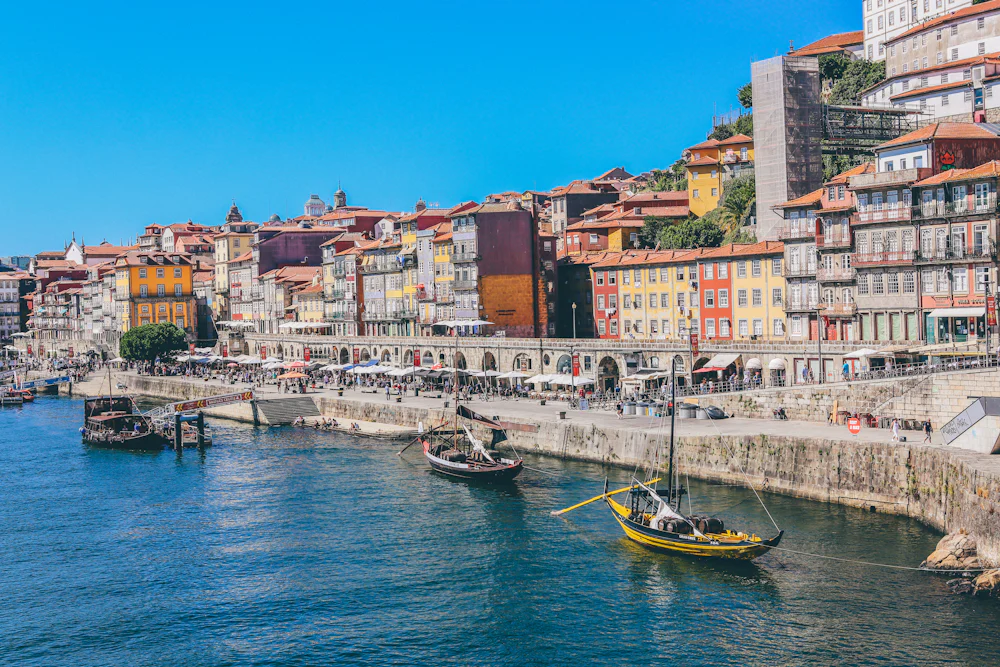
Land, drop your bags, and go straight to the river. The Ribeira is Porto’s UNESCO-listed old town, a tangle of narrow streets and tall, tile-faced houses tumbling down to the Douro’s edge. This is where I always start, because it orients you to the whole city — you can see the six bridges, the port wine lodges across the water in Vila Nova de Gaia, and the working rhythm of a riverside city that’s been doing this for a thousand years.
- Morning/early afternoon: Settle into your accommodation, then walk down to Praça da Ribeira, the main riverside square. Grab lunch at one of the tascas along Rua da Fonte Taurina — nothing fancy, just grilled fish and a glass of vinho verde.
- Afternoon: Cross the Dom Luís I Bridge on foot via the upper deck (built by a student of Gustave Eiffel, and yes, it shows) for the best panoramic view of the Ribeira skyline. This walk alone is worth the trip.
- Late afternoon: On the Gaia side, do a proper port wine cellar tour and tasting. Graham’s Port Lodge and Sandeman are the two most famous and both run excellent, well-organised tours with tastings — book ahead via GetYourGuide for the popular ones in high season.
- Evening: Dinner back on the Ribeira side. If you want a proper introduction to Porto’s most beloved (and most caloric) dish, order a francesinha — a meat-stuffed sandwich drowned in melted cheese and a beer-and-tomato sauce. Café Santiago is one of the most famous spots for it in the city.
Day 2: Porto’s Landmarks, in Sequence
This is the day to properly explore the city centre, and I’d walk it in this order, which follows a natural loop uphill from the river and back down again:
- Livraria Lello — Widely (if a little breathlessly) called one of the most beautiful bookshops in the world, with a carved wooden staircase that’s genuinely stunning even through the crowds. Buy timed entry tickets in advance online via the official Livraria Lello site — this sells out and queues without a ticket can run over an hour.
- Igreja dos Carmelitas and Igreja do Carmo — Two churches standing almost side by side, separated by what’s said to be the narrowest house in Porto, with the famous blue-and-white azulejo tile facade on the Carmo side. Free to view from outside; small fee to go in.
- Torre dos Clérigos — Climb the 240-odd steps of this baroque bell tower for the best 360-degree view over Porto’s rooftops. Tickets are available on-site or through the official Torre dos Clérigos website — go early to beat both the heat and the queue.
- São Bento Railway Station — Not a place you’re catching a train from necessarily, but a destination in its own right. The entrance hall is covered floor to ceiling in roughly 20,000 azulejo tiles depicting scenes from Portuguese history. It’s free to walk in and it takes ten minutes to properly appreciate — don’t skip it.
- Porto Cathedral (Sé do Porto) — A short uphill walk from São Bento, this fortress-like Romanesque cathedral has a lovely cloister and one of the best viewpoints over the Ribeira rooftops from its terrace.
- Miradouro da Vitória — End the day here as the light softens. It’s one of the least crowded viewpoints in the city and gives you a gorgeous, low-key sunset view over the tiled rooftops down to the river.
For dinner, I’d point you toward Cantinha 32, a cosy spot doing elevated traditional Portuguese cooking, or if you want to push the boat out on your last night in the city, Pedro Lemos, a Michelin-starred restaurant with a genuinely inventive take on northern Portuguese ingredients — check the Michelin Guide for current listings and book well ahead.
Day 3: Pick Up the Car and Drive into the Douro Valley
Today is a travel day, but a spectacular one. Pick up your rental car in Porto mid-morning and drive east on the A4 toward Amarante, then pick up the N108/N222 which hugs the river for the final stretch. Budget around 2 to 2.5 hours to reach Pinhão, the small town that makes the best base for exploring the valley, though you’ll want to stop constantly for photos, so realistically block out most of the day.
- En route: Stop at the Miradouro de São Leonardo da Galafura, just outside Peso da Régua. This is widely considered one of the finest viewpoints over the entire Douro Valley, and it’s easy to reach by car with a small parking area right at the lookout.
- Peso da Régua: A good lunch stop and the traditional “capital” of the Douro wine region. Wander the riverfront and, if you have time, pop into the small Douro Museum for context on the region’s wine history before continuing on.
- Continue to Pinhão: The final approach on the N222 is regularly ranked among the most scenic driving roads in the world, winding along the river with vineyard terraces rising on both sides. Take it slow.
- Arrive in Pinhão: This tiny riverside town is postcard-perfect, and its train station is worth a five-minute stop even if you’re not catching a train — the platform walls are covered in azulejo panels depicting the grape harvest.
Check into a quinta for the next two nights if your budget allows — staying on a working wine estate is one of the best things you can do in the Douro, and most offer half-board with dinner included. TripAdvisor’s Pinhão hotel listings are a good starting point for comparing quinta stays.
Day 4: Quintas, Viewpoints, and the Heart of the Douro
This is the centrepiece day of the whole trip, and I’d structure it as a loop out from Pinhão and back:
- Morning — Quinta do Bomfim: Start with a vineyard tour and tasting at Quinta do Bomfim, right on the edge of Pinhão and one of the most historic Symington family estates. Book directly through Symington Family Estates — tours run at set times and it’s worth reserving ahead.
- Mid-morning — Miradouro do Casal de Loivos: A short drive up out of Pinhão brings you to what many consider the single best viewpoint in the entire valley, looking down over the sweeping horseshoe bend of the river and its terraces. Go for the light in the late morning to early afternoon.
- Lunch — Quinta Nova or Quinta do Seixo: Book a long lunch on a terrace overlooking the vines. Quinta Nova is well known for its restaurant with sweeping valley views, while Quinta do Seixo (Sandeman’s flagship Douro estate) has striking modern architecture cut into the hillside.
- Afternoon — Sabrosa or a boat ride: Either take a short scenic detour to Sabrosa, birthplace of Ferdinand Magellan, for a quieter village wander, or head back to Pinhão for a river cruise on a traditional rabelo boat, which gives you the valley from water level. These can be booked easily through GetYourGuide’s Douro Valley listings.
- Evening: Dinner at your quinta, ideally on the terrace as the sun sets over the terraces and the light turns the whole valley gold and pink. This is the moment that will stay with you longest.
Day 5: One More Viewpoint, Then Back to Porto
Before you drive back, make time for one more stop that most visitors miss: the Miradouro de São Salvador do Mundo near Provesende, a quieter, less-visited viewpoint with a chapel and sweeping views, good for a peaceful last look at the valley without crowds. From there, retrace your route back along the N222/N108 to Porto, dropping the rental car at either the airport or a city-centre depot depending on your flight time.
If your flight isn’t until evening, use the extra hours for one last wander through the Ribeira, a final pastel de nata from Manteigaria, and a coffee looking out over the river you’ve now followed from mouth to source.
A Little History, Because It Makes the Wine Taste Better
I’m not usually one for history lessons on a travel blog, but the Douro is different — understanding roughly what you’re looking at genuinely changes how you experience it. The Douro Demarcated Region was established in 1756, making it one of the oldest protected wine regions on the planet, decades before anyone in Bordeaux or Rioja got around to formalising theirs. For centuries, the only way to get the wine from the valley to the cellars in Vila Nova de Gaia was down the river itself, on flat-bottomed rabelo boats crewed by men who navigated the Douro’s once-treacherous rapids with nothing but a long steering oar and a lot of nerve. The river was tamed by a series of dams in the mid-20th century, which made the rapids disappear but also made the valley far easier — and safer — to explore by boat, which is part of why a river cruise is worth building into your itinerary.
The terraces themselves come in three distinct styles if you know what to look for: the older, narrower socalcos built with dry stone walls by hand, which you’ll spot on the steepest slopes and which are backbreaking to farm even today; the wider, mechanised vinha ao alto rows that run straight up and down the hillside for tractor access; and the patamares, a middle-ground terracing style introduced more recently. Once you start noticing the difference, the whole valley reads differently — you can literally see a couple of hundred years of agricultural history stacked on top of itself on a single hillside.
Where to Stay in Porto: Picking the Right Neighbourhood
Porto is compact, but where you base yourself still shapes the trip.
- Ribeira: The most atmospheric choice and where I’d stay if it’s your first visit. You’re steps from the river, the restaurants, and the bridge walk to Gaia. It’s touristy in the height of summer, but it’s touristy for a reason — everything is walkable from here, and waking up to the sound of the river and the gulls is worth the slightly higher price tag.
- Cedofeita and Baixa: A little further from the river but closer to Livraria Lello, the Clérigos Tower, and Porto’s best independent coffee shops and vintage stores. Quieter in the evenings, and generally better value than Ribeira.
- Vila Nova de Gaia: Staying on the south bank puts you right among the port wine lodges, and you still get an easy 10-15 minute walk across the Dom Luís I Bridge into central Porto. Some of the best skyline views of Porto’s Ribeira are actually from this side, especially from a rooftop bar at sunset.
- Foz do Douro: If you want a beach-town feel and don’t mind a short tram or Uber ride into the centre each day, Foz sits where the river meets the Atlantic and has a completely different, more residential, seaside energy.
Eating and Drinking Your Way Through Porto
Porto is not a subtle food city, and I mean that as the highest compliment. This is hearty, generous cooking built for people who work outdoors and drink fortified wine with lunch, and I wouldn’t have it any other way.
- Francesinha: Beyond Café Santiago, locals will also point you to Brasão Cervejaria, which does a lighter, craft-beer-friendly take on the classic sandwich in a stylish, industrial-chic setting.
- Bacalhau (salt cod): Portugal claims there are 365 ways to cook it, one for every day of the year, and Porto takes that claim seriously. Try it at a traditional tasca in the Ribeira, where it usually comes baked with potatoes, onions, and olive oil (bacalhau à Gomes de Sá).
- Tripas à moda do Porto: Tripe stew is the dish that gave Porto’s residents their nickname, “tripeiros.” Not for everyone, but if you want to eat like a local, this is the deep-cut order.
- Petiscos: Portugal’s answer to tapas — small plates of octopus, grilled chouriço, cheese, and bread meant for sharing over a long, unhurried lunch. Most tascas along Rua das Flores do this well.
- Cafés and pastelarias: Beyond Manteigaria for pastéis de nata, Café Majestic on Rua de Santa Catarina is the grand, Belle Époque coffee house every guidebook mentions — go for the setting and the coffee, not the food, which is overpriced for what it is.
- Port wine tasting beyond the lodges: Vinologia is a small, knowledgeable wine bar in the Ribeira specialising in rare and aged colheita ports, run by a genuine enthusiast rather than a tour operator, and a nice contrast to the big lodge tours.
Optional Day 6: Extend to Foz Côa or Lamego
If you have a sixth day to spare, here are the two extensions I’d recommend, depending on what you’re into.
For prehistoric art: Vale do Côa
About an hour east of Pinhão, the Côa Valley Archaeological Park protects the largest collection of open-air Paleolithic rock art in the world — engravings of horses, aurochs, and ibex carved into riverside schist between roughly 22,000 and 10,000 years ago. Access is by guided tour only, and tours need to be booked in advance through the official Fundação Côa Parque website, since numbers are limited to protect the site. It’s a genuinely humbling detour if you have the extra day.
For baroque grandeur: Lamego
South of the river from Peso da Régua, Lamego is home to the extraordinary Santuário de Nossa Senhora dos Remédios, a baroque sanctuary reached by a monumental double staircase of over 600 steps, zigzagging up the hillside past fountains and azulejo panels. It’s one of the most photographed staircases in Portugal and well worth the detour, plus the town itself is known for its smoked ham and sparkling wine, a nice change of pace from the still reds and ports further up the valley.
Budgeting for the Trip
Portugal remains one of Western Europe’s better-value destinations, though prices have climbed in Porto over the past few years as the city has become more popular. As a rough daily guide, per person:
- Budget traveller: €60-90/day — guesthouse or hostel private room, tasca meals, public transport in Porto, budget quinta tour.
- Mid-range: €120-200/day — boutique hotel or quinta stay, one nicer restaurant meal daily, a few paid tours and tastings, car rental split between two people.
- Higher-end: €250+/day — design hotels, Michelin-listed dining, private Douro tours and river cruises, premium quinta lunches with wine pairings.
Car rental in Portugal typically runs €35-60/day for a compact car in shoulder season, more in July and August — book ahead through a comparison site or directly with Europcar, Sixt, or Hertz for the best rates.
Frequently Asked Questions
Do I need to speak Portuguese?
No — English is widely spoken in Porto’s tourist areas, hotels, and most quintas. In smaller Douro villages, a phrasebook or translation app helps, but Portuguese hospitality tends to bridge the gap regardless.
Is the Douro Valley worth it if I don’t drink wine?
Absolutely. The landscape, hiking, viewpoints, and river cruises stand entirely on their own. Most quintas are also happy to serve non-alcoholic grape juice pairings alongside a tasting menu if you’d rather skip the wine itself.
How many days is realistically enough?
Three days is a workable minimum (one full day in Porto, one travel-and-explore day in the Douro, one for the return), but five lets you actually breathe. If you can stretch to six or seven, add Foz Côa or Lamego, or simply slow down and do fewer things properly.
Can I do the Douro as a day trip from Porto without a car?
Yes, via an organised tour (most include hotel pickup, a boat ride, and lunch, bookable through GetYourGuide) or the scenic train to Pinhão and back. It’s a lovely day, but you’ll cover far less ground and see fewer viewpoints than with your own car and an overnight stay.
What to Pack for Porto and the Douro
Northern Portugal has a genuinely different climate to the Algarve you might be picturing — Porto sits on the Atlantic and gets real rain, especially between October and April, while the Douro inland is drier and hits proper Mediterranean-style heat in summer. A few things I’ve learned the hard way over multiple trips:
- Comfortable, grippy walking shoes. Porto’s cobblestones (calçada portuguesa) are beautiful and slick, especially when wet, and the city is genuinely hilly — you’ll be going up and down constantly between the Ribeira and the upper town.
- A light rain layer, even in summer. Porto gets sudden showers that Lisbon and the Algarve rarely see. It usually passes in twenty minutes, but you don’t want to be caught without something.
- Sun protection for the Douro. The valley’s terraced hillsides offer almost no shade, and the reflected heat off the schist terraces in July and August is intense. A hat and proper sunscreen aren’t optional.
- A light jacket for evenings. Even in high summer, temperatures drop noticeably once the sun goes down, both on the river in Porto and up in the Douro hills.
- A crossbody bag or money belt. Porto is a safe city by European standards, but the Ribeira and São Bento station areas do see opportunistic pickpocketing, as any busy tourist zone does.
A Few Honest Notes From Someone Who’s Done This Trip More Than Once
I’ll be straight with you on a couple of things most glossy guides skip over. First, Livraria Lello is beautiful, but it is also mobbed almost every day of the year now, and the “beautiful staircase moment” you see in photos usually involves a five-minute wait in a scrum of other phones held overhead. Go right at opening time, or accept it for what it is — a lovely bookshop having a very busy day — and don’t let it define your impression of Porto, because the city has so much more understated beauty elsewhere that costs nothing and has no queue.
Second, the N222 into the Douro is rightly famous, but it can also get busy with tour buses and other travellers doing exactly what you’re doing, especially on weekends in September and October. If you can, do the drive itself on a weekday, and save weekend mornings for a quieter viewpoint hike instead.
Third — and this is the one that took me two trips to learn — don’t overbook the Douro. It’s tempting to plan five wineries in two days because they’re all so appealing on paper, but the valley rewards slowness more than almost anywhere else I’ve driven in Europe. Two well-chosen quintas with long lunches beat five rushed tastings every time. Leave gaps in the schedule for the drive itself, for the unplanned stop at a miradouur you didn’t know about, for the nap on a quinta terrace with a glass of white port and tonic in your hand. That’s really what this trip is for.
Pairing This Trip With Braga and Guimarães
If you’ve got more than a week and want to round out the northern Portugal picture, Braga and Guimarães sit within an hour of Porto and pair naturally with this itinerary — either tacked onto the front, before you head into the Douro, or the back, after you return the rental car.
- Guimarães calls itself the birthplace of Portugal, and it’s not wrong — this is where the nation’s first king, Afonso Henriques, was born, and the walled medieval centre around the castle and the Palace of the Dukes of Braganza is one of the best-preserved in the country. It’s an easy half-day trip by train from Porto’s Campanhã station.
- Braga is Portugal’s religious capital and home to the extraordinary Bom Jesus do Monte sanctuary, another zigzagging baroque staircase (Portugal does love a dramatic staircase) climbing through terraced gardens to a hilltop church, with a funicular available if you’d rather not do all 600-plus steps on foot.
Both are reachable by direct train from Porto’s São Bento or Campanhã stations in under an hour, so if you’re tight on time, you genuinely don’t need to add a rental car day for either — this is one of the rare add-ons to this itinerary where public transport is not just sufficient but arguably the better choice, since parking in both old towns is limited.
The Bigger Picture: Why This Corner of Portugal Sticks With You
I’ve done a lot of van-life miles across Iberia at this point — the Algarve’s cliffs, the wild Atlantic coast of the Alentejo, the green hills of Galicia just over the Spanish border — and the Porto-to-Douro run is still the trip I recommend first to anyone asking where to start in Portugal. Part of it is the sheer efficiency of the itinerary: you get a genuinely great city and one of the most dramatic landscapes in Europe within a two-and-a-half-hour drive of each other, connected by a train line that’s scenic enough to be an attraction on its own. But mostly it’s the pace the region seems to insist on. Porto wants you to wander, not rush. The Douro wants you to sit on a terrace with a glass of tawny port and just watch the light change on the terraces for an hour. Somewhere between the tiled church facades of the city and the impossible staircase vineyards up the river, you stop checking things off a list and just start noticing where you are. That’s the whole point of a trip like this, and it’s why, three visits in, I’m already thinking about when I’ll go back.
Practical Tips for Planning Your Trip
- Best time to visit: Late September through October is harvest season in the Douro and genuinely magical, though busy at the quintas. May and June offer green terraces and fewer crowds. Summer (July-August) is hot — expect 35°C+ in the valley.
- Currency and language: Euros; Portuguese is the local language but English is widely spoken in tourist areas, less so in small Douro villages, where a few basic phrases go a long way.
- Booking ahead: Reserve Livraria Lello tickets, port lodge tours, and quinta lunches in advance during summer and harvest season — these sell out.
- Journey planning tool: For comparing train, bus, and driving options at any point in this itinerary, Rome2Rio is genuinely useful for double-checking logistics.
- Tolls: Portuguese motorways use an electronic toll system that can trip up rental cars without a transponder — ask your rental company about toll handling before you drive the A4.
- SIM cards and connectivity: Coverage is solid in Porto and along the main Douro road corridor, though it does drop out on some of the smaller quinta access roads up in the hills. Download offline Google Maps for the Douro region before you set off, just in case.
- Tipping: Not obligatory in Portugal, but rounding up or leaving 5-10% at sit-down restaurants is appreciated and increasingly common in more touristed spots like the Ribeira.
- Opening hours: Many smaller Douro-region shops and even some tasca kitchens close for a few hours in the early afternoon, and quite a lot of Porto’s smaller boutiques close on Sundays and Monday mornings — plan accordingly if shopping is on your list.
- Water on quinta terraces: Always ask for a jug of water alongside your wine tasting or lunch — the Douro sun is stronger than it looks, and staying hydrated between tastings makes the whole day more enjoyable.
- Photography permissions: Most quintas are relaxed about photos in their public tasting areas and vineyards, but always ask before photographing inside working cellars or barrel rooms, since some estates restrict this for insurance and production reasons.
Porto and the Douro together give you everything a great European trip should: a city with real character and history, and a landscape that genuinely earns every superlative thrown at it. Land in Porto, walk the Ribeira, climb the Clérigos tower, then get in a car and let the N222 pull you east into the vineyards. Take it slow — this is a place that rewards lingering, not rushing.
Photo by Nick Karvounis on Unsplash.